US Trade Map Shows PoK as Indian Territory, Marks Shift in Washington’s Cartographic Stance
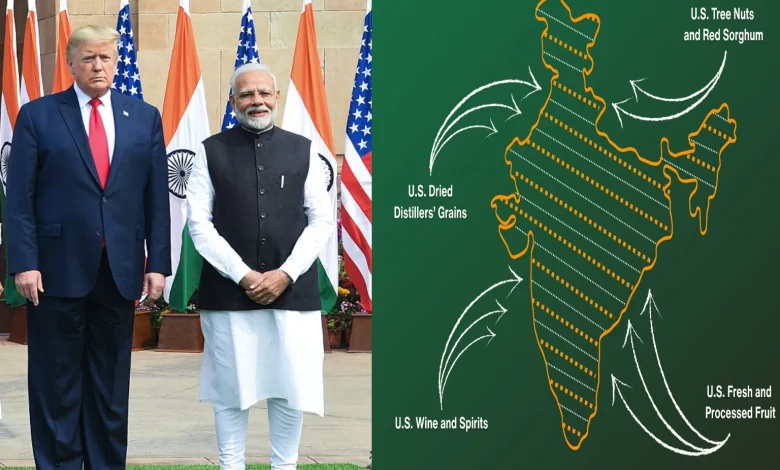
A map released by the United States Trade Representative’s office during the announcement of an interim trade deal framework with India has depicted Pakistan-occupied Kashmir and Aksai Chin as Indian territory, drawing significant attention to what appears to be a departure from previous American cartographic practice.
The map, made public on Saturday alongside the trade agreement details between New Delhi and Washington, showed the entire Jammu and Kashmir region including areas under Pakistani control as part of India. It also placed Aksai Chin, a region claimed by China in northeastern Ladakh, within Indian borders.
This representation is consistent with India’s official position on its territorial boundaries. Historically, maps issued by the US government or the State Department often portrayed Pakistan-occupied Kashmir separately, generally reflecting Islamabad’s claims. The current map from the Trump administration makes no such differentiation, indicating a notable shift from earlier US representations.

Shift Comes Amid Recalibrated India-US Relations
India has long asserted that Jammu and Kashmir and Ladakh constitute integral parts of the nation and that its territorial sovereignty does not depend on external endorsement. Nevertheless, the American move holds strategic importance, signaling a clear change from previous depictions.
The development is particularly significant given the recent recalibration of India-US relations under President Donald Trump. Earlier, Washington had imposed substantial 50 percent tariffs on Indian goods the steepest among US allies following protracted trade negotiations that extended nearly a year.
Under the newly established interim agreement, tariffs on Indian products have been lowered to 18 percent, positioning them among the most favorable in Asia. Penalty duties associated with Russian oil purchases have also been withdrawn.
Re-hyphenation Debate Returns to Focus
The map’s publication coincides with reports of Trump’s efforts to re-hyphenate India and Pakistan, reversing the de-hyphenation policy maintained since the George W Bush presidency. This development has been leveraged by the Opposition in India to question the government’s foreign policy approach.
Adding complexity to the situation are Trump’s recurring assertions that he facilitated a ceasefire between India and Pakistan during military operations in May last year. India’s Ministry of External Affairs has categorically refuted these claims, emphasizing that all matters between the two nations are addressed through bilateral channels. Trump has also previously criticized India sharply, including describing its economy as “dead”.
Aksai Chin Depiction Highlights China Dimension
Beyond the Pakistan aspect, the map also illustrated Aksai Chin in northeastern Ladakh as Indian territory. China has maintained its claim over this region and has rejected India’s protests.
The Ministry of External Affairs has consistently objected to what it terms inaccurate portrayals of India’s boundaries particularly regarding Jammu and Kashmir and Arunachal Pradesh in maps used by foreign governments and international organizations. The latest US map appears to directly acknowledge those longstanding concerns.
Defence analysts responded promptly to the development. Retired army officer Major Gaurav Arya shared his views on X, commending the depiction as a favorable development.
Uncomfortable Development for Pakistan
The timing may prove challenging for Pakistan, particularly as its diplomatic engagement with Washington has strengthened over the past year.
Pakistan’s army chief, Field Marshal Asim Munir, has traveled to the US on multiple occasions and met Trump twice, including at a prominent lunch meeting in June. That encounter was notable as the first instance of a US president hosting Pakistan’s army chief without civilian leadership in attendance.
Islamabad has also put forward Trump’s name for the Nobel Peace Prize. However, under the revised tariff framework, Pakistan now confronts higher duties than India, with Pakistani goods subject to 19 percent taxation compared to India’s 18 percent.