
Trump ‘Mandatorily Requests’ Saudi Arabia, Pakistan, Turkey, Others to Join Abraham Accords; Hints Iran Could Follow
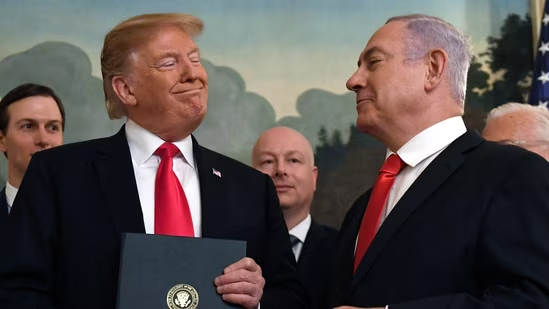
US President Donald Trump has called on Saudi Arabia, Qatar, Pakistan, Turkey, Egypt, and Jordan to immediately sign the Abraham Accords, framing the push as part of a broader deal tied to the ongoing Iran war negotiations.
In a post on his Truth Social platform, Trump wrote that he was “mandatorily requesting that all Countries immediately sign the Abraham Accords,” naming the six nations. The UAE and Bahrain, also mentioned in the post, were among the original signatories of the US-brokered normalisation pact with Israel. Egypt and Jordan have had formal relations with Israel since 1979 and 1994 respectively, but are not party to the accords.
Trump also raised the possibility of bringing Iran into the agreement. “If Iran signs its Agreement with me, as President of the United States of America, it would be an Honor to have them also be part of this unparalleled World Coalition,” he wrote. “The Middle East would be United, Powerful, and Economically Strong, like perhaps no other area, anywhere in the World.”
Trump said he was instructing his representatives to begin and complete the process of signing the named countries into the accords.



What are the Abraham Accords?
The Abraham Accords are a series of US-brokered agreements normalising diplomatic relations between Israel and several Arab and Muslim-majority states. Signed in 2020, the original signatories were the UAE, Bahrain, and Morocco. Sudan also signed but has not ratified the agreement in its parliament. In early 2026, Kazakhstan formalised its entry after agreeing to join the pact in November 2025.
Also Read:WHO Chief Reports 220 Suspected Deaths In Congo Ebola Outbreak
Trump’s inclusion of Pakistan in the list marks another expansion of the accords beyond the Arab League.
The Arab world’s reservations
The accords have been viewed by many Arab nations as a sidelining of the Palestinian cause. The agreements made no mention of the Israel-Palestinian conflict, which has remained a central sticking point. The Arab League’s 2002 Arab Peace Initiative had set the establishment of a Palestinian state and Israeli withdrawal from occupied territories as preconditions for normalisation — a framework Israel largely rejected.
By 2020, some Arab states moved toward normalisation with Israel primarily to counter Iranian influence in the region, building on unofficial security cooperation that had developed through the 2010s. The UAE’s signature came after it secured a commitment from Israel to suspend West Bank annexation plans.
The war in Gaza stalled further progress, with several Arab governments stating that recognition of Israel would only come alongside a credible two-state solution. Saudi Arabia’s Crown Prince Mohammed bin Salman told Trump in November 2025 that the kingdom was open to joining the accords provided there was “a clear path” to a Palestinian state.
The Iran war has since complicated the picture further. Bahrain, Saudi Arabia, Oman, Kuwait, and the UAE came under attack from Iranian forces due to the presence of US military bases on their soil and their ties with Washington — a development that has reshuffled the region’s political calculations.