
Saudi Arabia Uranium Find, $24.3 Billion F-35 Sale and mBridge Exit Raise Questions Over Riyadh’s Strategy Under Trump
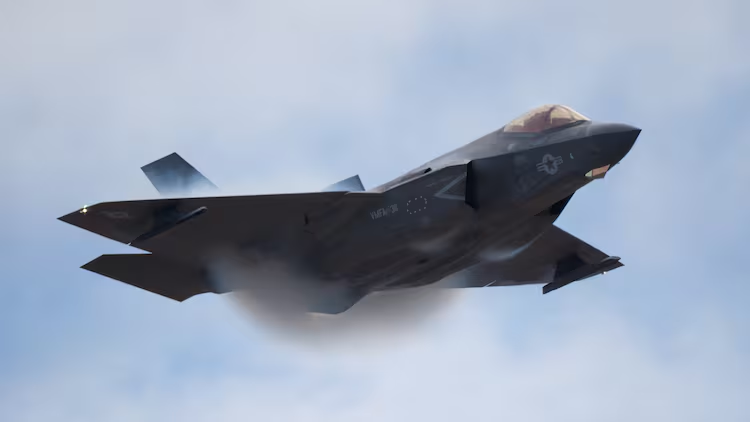
Two announcements from Riyadh and Washington in the same week of mid-September have drawn attention because of their timing. Saudi Arabia’s energy minister announced the discovery of roughly 110 million tonnes of ore near Medina, containing promising uranium concentrations and high levels of rare earth minerals. About three days later, the US State Department notified Congress that it had approved a potential $24.3 billion sale of 48 Lockheed Martin F-35 Lightning II fighter jets. It is the first time an Arab state could get access to America’s most advanced fifth-generation stealth aircraft.
The timing comes against the backdrop of Saudi Arabia’s fight with Iran-backed Houthis in Yemen, Washington’s reluctance to intervene militarily on Riyadh’s behalf, and a possible understanding between the US and the Houthis. This has prompted questions over whether the Arab kingdom is using economic and strategic leverage to win favour with US President Donald Trump. In other words, there is speculation over whether this is a strategic deal or a bribe.
What the F-35 package includes
The proposed package covers 48 conventional-takeoff-and-landing F-35s, 49 Pratt & Whitney F135 engines (48 installed and one spare), secure communications, electronic warfare support, training, spares and logistics. The State Department described the sale as essential for “improving the security of a major non-Nato ally” and for strengthening homeland defence and interoperability, while insisting it would not alter the regional military balance.
The department’s language appears carefully calibrated to address the US commitment to Israel’s qualitative military edge in the Middle East. The US and Israel have used F-35 Lightning II stealth fighters in more than 3,000 combat strikes against Iran this year, though one of the aircraft was reportedly hit by Iranian fire.



The Saudi Embassy in Washington welcomed the move. “The proposed F-35 sale reflects the strength and enduring nature of the Saudi-US strategic partnership and the continued advancement of our defense cooperation. For decades, Saudi-US security cooperation has contributed to regional stability, strengthened our collective defense capabilities, and advanced our shared security interests,” it said.
Saudi exit from China-led mBridge project
Adding to the speculation is Saudi Arabia’s exit from China’s digital currency project. According to a Financial Times (FT) report on Sunday, Riyadh has withdrawn from the Beijing-led mBridge project. The initiative uses blockchain technology to let central banks conduct cross-border transactions directly, potentially reducing reliance on traditional, US dollar-dominated payment systems such as SWIFT.
The Saudi Central Bank (SAMA) confirmed that it stopped participating in the project after completing a planned technical test in May 2025. Sources cited by the FT said Saudi Arabia sought to avoid public attention and potential pressure from the US, while an insider told the newspaper that SAMA continues to work with the programme quietly.
The sequence of events, beginning with the uranium find, followed by reports of US-Houthi contacts, the F-35 clearance and the exit from the China-led initiative, has led analysts and observers to ask whether Riyadh is engaged in high-stakes transactional diplomacy.
Saudi Arabia has long sought the F-35s, and earlier efforts under previous administrations stalled over concerns about Israel’s edge in the region. Trump had signalled openness in May last year, including a nearly $142 billion arms package that the White House described as the largest defence cooperation agreement of its kind. The latest F-35 step advances that trajectory, even though Saudi Arabia’s immediate threats from the Houthis and the blockade of the Bab el-Mandeb Strait are not challenges that advanced stealth fighters can resolve.
Uranium discovery and Saudi nuclear ambitions
Saudi Energy Minister Prince Abdulaziz bin Salman announced the uranium find at the International Atomic Energy Agency General Conference in Vienna. Geological studies at the Jabal Sayid project in the Medina region point to an estimated 110 million tonnes of ore with high concentrations of rare earths, especially heavy elements, along with promising uranium levels. This is ore volume, not refined uranium or pure rare-earth concentrates, and recoverable quantities will depend on grade, extraction economics and processing.
The announcement nonetheless carries weight. It follows a July 2026 US-Saudi civil nuclear cooperation framework that opens the door for American companies to help develop the kingdom’s civilian nuclear programme and, critically, gives Riyadh a pathway toward domestic uranium enrichment under agreed safeguards. Saudi Arabia has also pursued energy diversification under Vision 2030, seeking to move beyond oil while building mining, critical minerals and nuclear capabilities.
The find also raises questions about the dual-use potential of the resource, particularly as the Middle East remains concerned about Iran’s nuclear programme. Riyadh has said its nuclear ambitions are civilian and will remain under international safeguards. Israel is currently the only country in the Middle East known to possess nuclear weapons.
The discovery also comes amid growing US-China competition. Trade between Saudi Arabia and China exceeded $100 billion annually by 2023-25, making China the kingdom’s top partner. Chinese FDI stock in Saudi Arabia rose 29% to $8.2 billion in 2024. Militarily, China has aided Saudi Arabia with solid-fuel ballistic missile production since the early 2020s.
Houthi challenge and US reluctance
Saudi Arabia’s most pressing military problem is not a high-tech air war but the Iran-backed Houthis in Yemen, described as stubborn, slipper-wearing and Toyota-riding. The group has attempted drone attacks on the holy city of Mecca and on Saudi ships in the Red Sea. It also recently mounted a ground offensive that seized key stretches of Yemen’s Red Sea coast, including areas that control approaches to the Bab el-Mandeb strait. Saudi-backed Yemeni forces have struggled to retake these areas.
The United States has shown no willingness to escalate on Saudi Arabia’s behalf. Reuters reported that US officials met Houthi representatives at the US Embassy in Muscat, Oman, over the weekend of mid-September, facilitated by Omani mediation. According to accounts, the Houthi side reiterated its commitment to the 2025 ceasefire with Washington, pledged not to attack American or Israeli vessels, and indicated that Saudi-linked shipping would remain a target. US Vice President JD Vance publicly acknowledged direct conversations with the Houthis.
Also Read:North Korea Fires Ballistic Missiles Into Sea, Japan and South Korea Confirm Launch
The dynamic has drawn pointed commentary. Defence expert Lt Gen DP Pandey wrote in a post on X, “Arm twist by not assisting in fight against Houthis. Saudis now give business to America by buying 24.3 Bn $ worth F35 fighter aircraft. This may not be of much use against Houthis immediately in any case.” Pandey essentially sees the deal as a possible transactional response to Washington’s reluctance to confront the Houthis directly, with Saudi Arabia offering the US a major defence contract in return for deeper strategic engagement.
Another X user wrote, “So US approved $24.3 billion F-35 jet sale to Saudi Arabia. But does it really help. Saudi is fighting Houthis – Sandal wearing and shoulder mounted gun fighters who have already shot Saudi fighter jet without any air defense (sic). More and bigger weapons do not matter much, so far the willingness to fight is not there, US is laughing all the way to the bank with money.”
The mismatch is real. Fifth-generation stealth fighters excel at penetrating sophisticated integrated air defences and conducting deep strikes against peer or near-peer adversaries. Against dispersed, low-signature guerrilla forces using man-portable systems, drones and irregular tactics, their operational value is practically of no use.
Strategic partnership or bribery?
The State Department’s clearance moves the sale into a 30-day congressional review window, and opposition is expected. The 2018 killing of Saudi journalist Jamal Khashoggi remains a major point of contention in Congress. US lawmakers from both parties had pushed for restrictions on arms sales to Saudi Arabia after Khashoggi was killed inside the Saudi consulate in Istanbul. The war in Yemen is another source of concern, with critics accusing Riyadh of conducting an air campaign that caused significant civilian casualties and humanitarian suffering.
More recent intelligence assessments, reported by The New York Times, point to a different risk: that China could gain access to sensitive F-35 technology through espionage in Saudi Arabia or through Beijing’s expanding military and security relationship with Riyadh. A Defense Intelligence Agency assessment highlighted Chinese military access to certain Saudi facilities, the presence of Chinese telecommunications equipment, including from Huawei and ZTE, in Saudi infrastructure, and questions about whether secure sites for F-35 systems could be adequately protected. These warnings have not halted the process.
Some critics, including online commentators, have framed the pattern in harsher terms. One verified handle stated, “Agent Orange has been paid by Saudi royals with about $1.9 billion… He’s sold out to the American media also… Trump Moves Ahead With F-35 Jet Sales to Saudi Arabia Despite Intelligence Concerns.”
Arms sales have long been a tool of US foreign policy, and Saudi Arabia has been the largest customer of American weapons for years. But the timing of the uranium announcement, the Houthi advances and reported US-Houthi contacts, followed by the F-35 sale and the exit from the Beijing-led digital currency initiative, has invited the interpretation that Riyadh may be using its money, minerals and arms purchases to get more from Trump. For now, the optics suggest that Saudi Arabia has resources to offer and is spending billions on America’s top fighter jet.