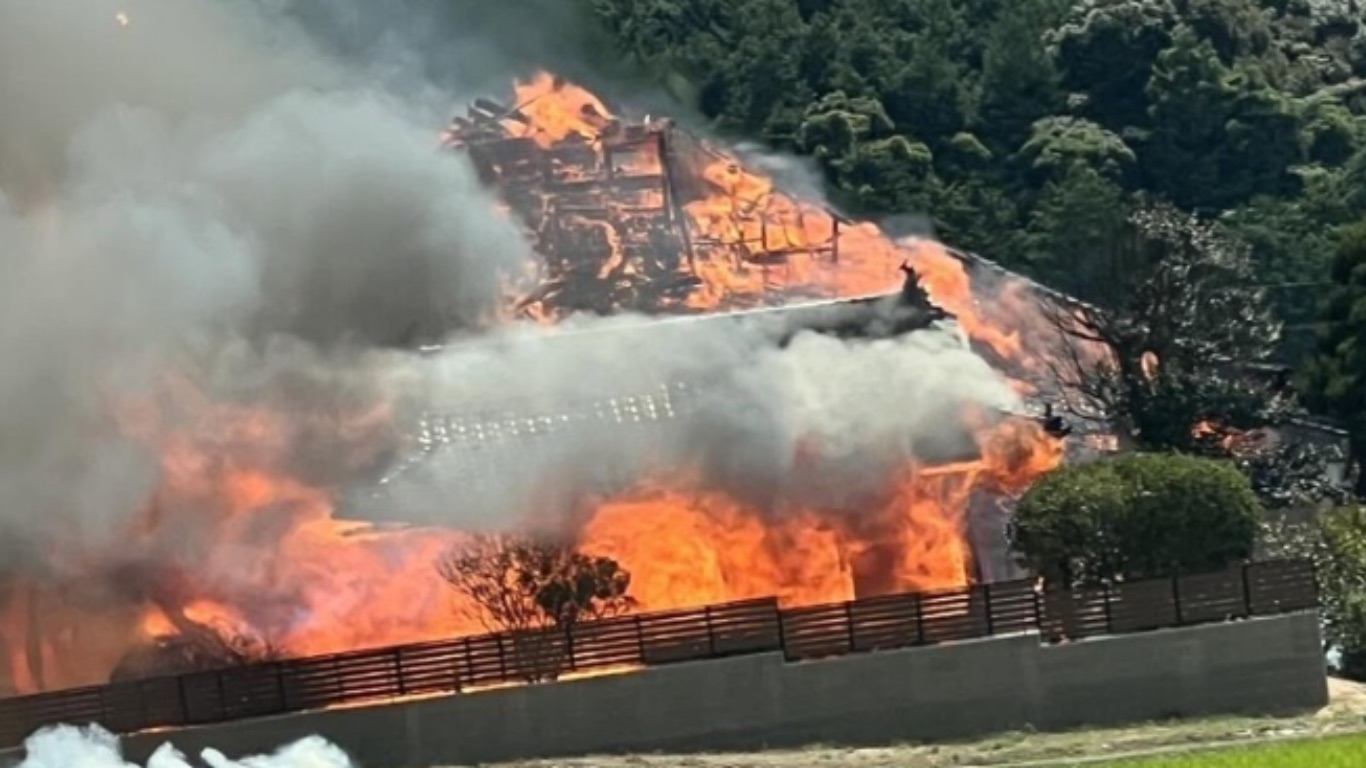
A series of fires at temples and shrines across Japan, including two incidents within the space of two days this week, has triggered a wave of speculation online, with some people on social media alleging that the incidents could be connected. At least nine major Japanese shrines and temple sites had been destroyed or seriously damaged by fire in the first five months of 2026. The latest such incidents occurred on August 31 and September 1.
On August 31, a major fire tore through the Meirin shopping arcade in Ise city, Mie Prefecture, around 700 metres from the outer shrine of Ise Jingu, one of Japan’s most important Shinto sites. Shinto is the indigenous spirituality and traditional belief system of Japan. The blaze spread through the densely packed shopping district, destroying dozens of buildings.
The following morning, a fire broke out at Seianji Temple in Sanyo-Onoda City, according to KRY Yamaguchi Broadcasting News. The temple was completely destroyed.
The incidents have now been seized upon by social-media accounts claiming the fires are too numerous to be coincidental. Some claimed that immigrants were deliberately setting fire to temples and shrines. Japanese authorities, however, said there was no evidence linking the fires to migrants, while official data showed temple and shrine fires have declined over the past decade.
British far-right activist Tommy Robinson, posting from his verified X account, wrote after the latest fires, “Another ancient temple ‘catches fire’ in Japan. These are not coincidences.”
The speculation has also widened beyond Japan, with some social media users claiming the fires were part of a broader global pattern. Posts pointed to churches and other places of worship in countries including the United States, arguing that religious sites were “mysteriously” catching fire around the world.
Another US-based right-wing account with more than 80,000 followers wrote, “Our Churches here in America keep getting burned down, and now temples in Japan are burning too. I don’t believe that’s a coincidence.”
The posts do not provide evidence establishing that the fires are connected or that they were deliberately started. But the speculation is being fuelled by a striking list of fires involving Japanese religious sites this year.
A String of Fires, and Many Unanswered Questions
According to a June report by independent portal Fire Risk Heritage, nine major Japanese shrines and temple sites had been destroyed or seriously damaged by fire in the first five months of 2026.
The list includes Suga Shrine in Kitakyushu, Fukuoka Prefecture, temples in Ehime, Shorinji Temple in Yamaguchi, Renshoji Temple in Toyama, Urufushine Shrine in Mie, Atago Shrine in Niigata, Daihoji Temple in Toyama, and Reikado Hall at Daishoin Temple on Miyajima.
Some of these incidents involved buildings of considerable historical or religious importance.
Daihoji Temple in Toyama, for instance, was a 573-year-old structure. Reikado Hall at Daishoin Temple housed a sacred flame that, according to tradition, had been maintained for about 1,200 years. The hall was destroyed in a May fire, although the flame itself was saved.
A fire at Shorinji Temple in Shimonoseki, Yamaguchi Prefecture, on February 20 killed two people.
That is the backdrop against which the latest Seianji fire is being viewed online. A person on X posted a long list of this year’s fires and wrote, “… Every time the same line comes back. Cause is under investigation. How many wooden halls have to go black before someone treats this as a pattern instead of bad luck?”
That post reflects the argument now circulating online — that the frequency of fires, the historical importance of some of the sites, and the fact that several fires remain under investigation, point to something more than a series of unrelated accidents.
Japan’s Own Data Does Not Show a Surge in Temple Fires
A June report by Japanese newspaper The Yomiuri Shimbun examined these claims and noted that groundless rumours alleging Muslims were responsible for a spate of fires at temples, shrines and a sake brewery across Japan had been spreading quickly on social media, despite police and firefighting authorities denying any truth to the allegations.
Yomiuri reported that fires had damaged at least 10 temples and shrines since January. Police and firefighting officials contacted by the newspaper said that, in eight of those cases, there was no indication the fires had been deliberately started by non-Japanese people. Two cases, including fires at shrines in Mie and Niigata, were still under investigation at the time.
The newspaper also reported that a separate fire at the Sasamasamune sake brewery in Fukushima had been dragged into the same online narrative, despite police saying there was no information suggesting arson or involvement by a particular foreigner or religion.
More importantly, official Japanese fire statistics do not support the claim that fires at religious sites have suddenly exploded.
According to figures from Japan’s Fire and Disaster Management Agency, fires at temples and shrines have seen a long-term decline falling from 83 in 2016 to under 60 in recent years, with cases classified as arson or suspected arson dropping significantly over the same period.
Also Read:Trump Administration Signs Drug Price Deal With India’s Sun Pharma And 8 Others
In other words, the long-term trend is downward, not upward.
That does not prove every fire in 2026 was accidental, nor does it rule out arson in individual cases. It does, however, make it difficult to use the number of recent incidents alone as evidence of a “conspiracy.”
Why Are These Buildings So Vulnerable?
There are also mundane explanations for why fires at Japanese temples and shrines can become particularly destructive.
Many traditional religious buildings are made largely of wood and can be centuries old. Dense construction, narrow streets and residential quarters within temple compounds can make firefighting difficult.
That was evident in the Ise fire. Firefighters said many of the buildings in the shopping district were old wooden structures. The covered arcade’s corrugated-metal roof also made it difficult for water to reach the flames. The fire ultimately spread across a large area of the shopping district.
Fire investigator Hiroaki Suzuki, quoted in Yomiuri’s June report, also pointed to everyday hazards such as dust accumulating around electrical outlets and causing short circuits. He cautioned that the absence of an obvious source of ignition does not, by itself, establish arson.
Japan has also been investing heavily in protecting historic structures from fire following the 2019 destruction of Shuri Castle. The Agency for Cultural Affairs launched a 13 billion Yen programme aimed at improving fire protection at 107 priority heritage sites. But Fire Risk Heritage noted that protection work has not been completed everywhere.
The proximity in time of the Ise-area fire and the Seianji Temple blaze has naturally drawn attention, particularly because they came after months of other fires at religious sites.
But there is currently no established evidence that these incidents form a coordinated series.
There is also no evidence in the material reviewed that connects the fires to Muslims, immigrants or any particular religious or political group. That distinction is especially important because an earlier wave of online speculation about temple fires in Japan had already resulted in false accusations against Muslims and foreigners.
Japan has suffered a number of serious fires at religious and heritage sites this year, and several investigations remain open, and social-media users are interpreting that sequence as evidence of a possible pattern.
-

-

-

-