
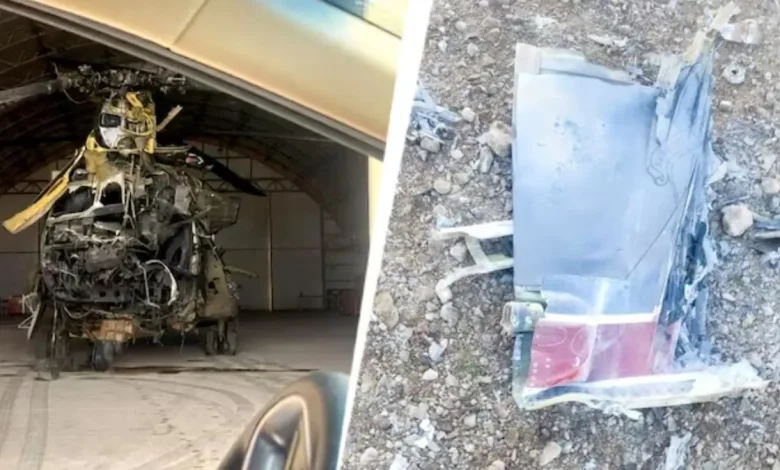
Tehran : It seems the days when flying over Iran was a walk in the park are over. Over the past 24 hours, two US military aircraft and two Black Hawk helicopters, which were involved in search efforts, were struck by Iran. While it does not mean that Iran is anywhere close to an equal military footing with the US, what it does is puncture US President Donald Trump’s claims of complete dominance over Tehran’s skies.
Despite the war now being in its second month, the US still seems to be unaware of Iran’s googlies. After shooting down a US F-15E Strike Eagle fighter jet on Friday, Iran’s Islamic Revolutionary Guard Corps (IRGC) credited a new, advanced defence system. Hours later, two Black Hawk helicopters, which were involved in search efforts for the F-15 crew, were also hit, but they made it out of Iranian airspace.
The developments come as a major battlefield setback for the US. It is the first time in more than 20 years that American fighter jets have been shot down by enemy fire. The last time that a US warplane was shot down during active combat was in Iraq during the 2003 invasion. Crucially, it underlines Iran’s continued ability to strike back despite repeated assertions by Trump and his aides of “complete control” over Iran’s skies and Tehran having “no anti-aircraft systems”.
While Iran has not revealed what took down the US jets, analysts believe it could be the Majid infrared air defence system or shoulder-fired missiles, which are harder to detect. The two US warplanes shot down by Iran were likely operating at lower altitudes, making them easy targets for these weapons. The Majid system, a surface-to-air missile platform, is also believed to be behind the March 19 hit on the US F-35, America’s most advanced stealth fighter aircraft.




As it doesn’t emit radar signals, it becomes significantly harder for aircraft to detect before a missile is fired at it. Its range is up to 8 km in distance and up to 6 km in altitude. Thus, it is highly possible that the US jets were operating within this range. Its detection capabilities hold the key. The infrared sensors have a range of up to 15 km. It is integrated with an external Kashef-99 phased-array system, which extends tracking capability to 30 km.
Since the missiles use passive infrared guidance rather than radar, it becomes difficult for detection by aircraft warning receivers. This explains how a highly sophisticated aircraft like the F-35 was likely targeted. Moreover, the enormous amount of heat generated by the F-35 is its Achilles’ heel. We had analysed in March how Iran could have struck the F-35. The Majid system is believed to have destroyed multiple US and Israeli high-value UAVs, most notably MQ-9 and Heron drones, since the start of the war on February 28.
Read Also : Pakistan to Repay UAE’s $3.5 Billion Loan in Three Tranches This April