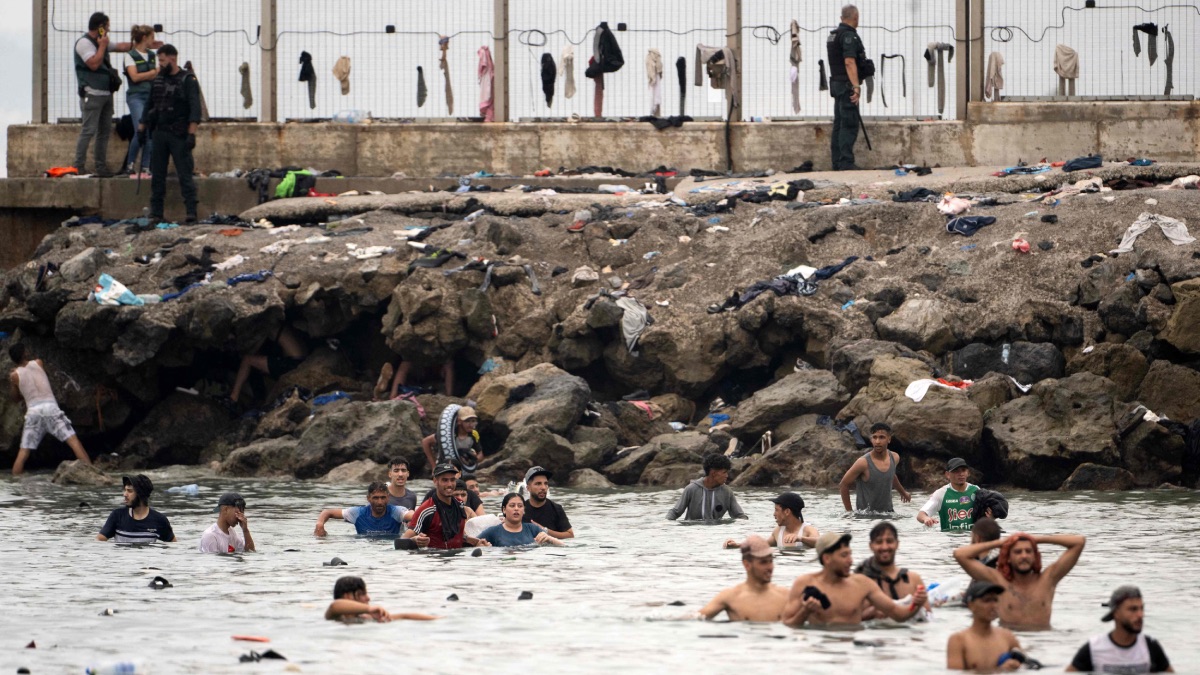
Thousands of migrants who crossed into Spain’s small North African territory of Ceuta began voluntarily returning to Morocco on Friday, a day after the mass crossing triggered chaos and left at least 57 people dead. Spanish authorities said the majority of the roughly 50,000 migrants who had entered by land and sea were already making their way back on their own.
To reach Ceuta, some migrants swam for miles, while others were met by authorities attempting to hold them back with water cannons, tear gas and warning shots. Those who died included people who drowned as well as others crushed in a stampede.
Why Are Migrants Returning Now?
Moroccan security forces used batons and tear gas to disperse crowds gathered at Ceuta’s entry points in an effort to stop further crossings into the small Spanish enclave on Morocco’s Mediterranean coast, Reuters reported.
On the Spanish side, military vehicles were positioned along stretches of the border, while dozens of migrants remained on a hillside inside Morocco, watching from a distance after failing to cross.
Many said they had been unable to find food or shelter once inside Ceuta.
A young Moroccan man from Tangier told Reuters: “Honestly, I don’t even know why I came, and now I’m going back. I haven’t eaten since lunch yesterday, even though I brought some money with me… What we’re doing is neither good nor enjoyable.”
‘Kicked Badly’
Ayman, a 20-year-old hairdresser from Larache, said he reached Ceuta on Wednesday after swimming for five hours. “There was no food inside Ceuta and we were kicked out badly by the (Spanish) army,” he said.
A Migration Crisis
Of the up to 60,000 people who crossed into Ceuta between Thursday and Friday morning, tens of thousands had returned to Morocco within hours, with Spain’s Interior Ministry putting the figure at nearly 48,000. Many had spent the night sleeping on the streets of the enclave as residents looked on in shock, alongside armed Spanish police and soldiers.
The scale of the influx — equivalent to around 70% of Ceuta’s population — pushed local authorities to call for police and military reinforcements to restore order, with the Ceuta government requesting that Spain declare a national emergency. Residents voiced alarm as thousands of mostly young men moved through the streets.
The crisis also had ripple effects beyond Spain’s borders: Italy temporarily reinstated some border controls on travel from Spain, while France ordered extra checks along its own border with Spain.
What Really Led to the Sudden Influx?
Ceuta’s authorities have linked this week’s surge in arrivals to a ruling by Spain’s Supreme Court issued earlier in July. The court held that migrants intercepted at sea cannot be immediately sent back under the enclave’s long-standing “border rejection” system, which has historically been used to swiftly return people attempting to enter by boat.
The ruling does not apply to migrants who cross by land, including those who scale the border fence.
Spanish Prime Minister Pedro Sánchez travelled to Ceuta on Friday and condemned the mass crossing as “a violation of Spain’s territorial integrity.” He blamed human smuggling networks for fuelling the crisis, saying they “deceive so many young people and ultimately lead many of them to their deaths,” whether at sea or within the city itself.
Some observers have also pointed to Spain’s comparatively open migration policy as a contributing factor, news agency AFP reported. Earlier this year, the Spanish government introduced measures granting residency and work permits to hundreds of thousands of migrants already living in the country without legal status.
With inputs from agencies
-

-

-

-