Balen Shah Named Nepal PM Candidate: How Kathmandu’s Mayor Rose From Rapper To Political Force In Just 3 Years
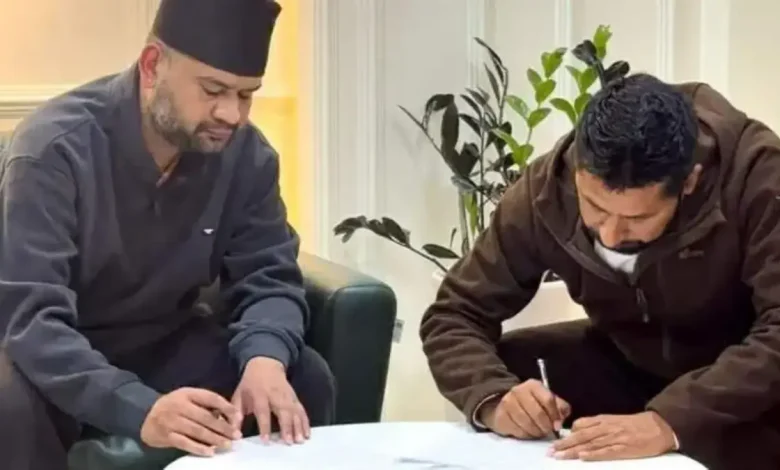
Balendra Shah, popularly known as Balen Shah and currently serving as Mayor of Kathmandu Metropolitan City, was declared a prime ministerial candidate on Sunday.
Balen and the Rastriya Swatantra Party (RSP) have reached an agreement to jointly contest the Nepal elections scheduled for March 5. According to BBC Nepali, both parties signed a seven-point agreement early Sunday morning.
Under the terms, Balen Shah will serve as parliamentary party leader and the prospective prime ministerial candidate for the upcoming elections, while Ravi Lamichhane will remain the central chairman of Rastriya Swatantra Party. The agreement also stipulates that the unified political entity will retain the name ‘Rastriya Swatantra Party.’
Balen was elected as Kathmandu Mayor running as an independent candidate and had not previously revealed any clear political affiliation. Following overnight negotiations, the 35-year-old has been positioned as parliamentary leader and the face of the PM candidacy under the seven-point accord.

Meanwhile, Ravi Lamichhane, chairman of RSP the fourth-largest party in the now-dissolved parliament will maintain his position. Per the agreement, Balen and his organization will contest elections using RSP’s election symbol granted by the Election Commission. Despite Balen’s group merging with RSP, the party’s name, flag, and election symbol will remain unchanged.
Who is Balen Shah?
When Balen Shah first became Kathmandu Mayor in May 2022, it stunned political observers across Nepal. During that election, Shah defeated Nepali Congress candidate Srijana Singh, securing 61,767 votes against Singh’s 38,341. The CPN-UML’s Keshav Satpait finished third.
Running as an independent without any established party backing, Balen defeated Nepal’s political establishment and proved himself. The former popular rapper was just 32 years old when he entered the mayoral race, generating widespread discussion not only among youth but also among Nepalis living abroad.
In 2017, ahead of Nepal’s local elections, Balen wrote on his Facebook page: “I will not vote today. I am not a candidate. I have graduated in civil engineering and am pursuing my master’s in structural engineering. I know how to build a country. I will vote for myself in the next election. I want my country’s progress and I cannot depend on others for this.”
Balen’s background
Balen Shah had no political party affiliation, no organizational structure, and no political experience. Born in 1990 in Gairigaon, Kathmandu, his father Ram Narayan Shah is an Ayurvedic doctor and his mother is Dhruvadevi Shah.
Balen completed civil engineering from White House Institute of Technology in Kathmandu and earned his master’s degree in structural engineering from Visvesvaraya National Institute of Technology in Karnataka. Though active in student politics during college, he entered electoral politics only in 2022 during Nepal’s local elections.
While campaigning in Kathmandu, Balen would say, “I won’t tell you much. Just vote for me in the election. Just give me one chance.”
The Madhesi identity debate
Senior journalist Roshan Janakpuri from Janakpur told BBC that Balen doesn’t come from a political background. His father is an Ayurvedic doctor, his wife Sabina Kafle is a public health worker, his brother is a chartered accountant, his brother-in-law a banker, and his sister a painter.
According to Janakpuri, Balen was quite active during India’s unofficial blockade in 2015 and also distributed relief materials during the earthquake. People appreciate Balen’s oratory skills and his willingness to speak openly against power structures. He is often seen wearing black sunglasses.
Several of Balen’s songs gained popularity, including “Aam Nepali Buba,” “Police Patrika,” and “Nepal Haseko,” which comment on Nepal’s social and political conditions. MP Amaresh Singh from Sarlahi district notes that Balen gained much of his popularity through the internet.
For a leader with Madhesi roots to become popular in Kathmandu and among hill communities represents a significant achievement in Nepal’s politics. However, Vijaykant Karna, who served as Nepal’s ambassador to Denmark, dismisses Balen’s Madhesi identity, stating that Balen was born in Kathmandu’s Newari area and never stood with Madhesi issues.
What Balen’s rise means
Prominent Nepali thinker and writer CK Lal compares Balen Shah’s emergence to Zelensky’s rise in Ukraine, noting that populist leaders often emerge from such movements. However, he cautions that such leadership can lack organizational structure and ideology.
When alternative politics is discussed in Nepal recently, Balen Shah’s name frequently surfaces. Why do people place such faith in him? In his mayoral manifesto, Balen proposed concepts ranging from digital government to idea banks, along with ambitious plans for education, health, and infrastructure.
After winning the mayoral election, Balen stated, “The road ahead is not easy. The test of our campaign begins now. The path we choose and the efforts we make will determine this city’s progress.”