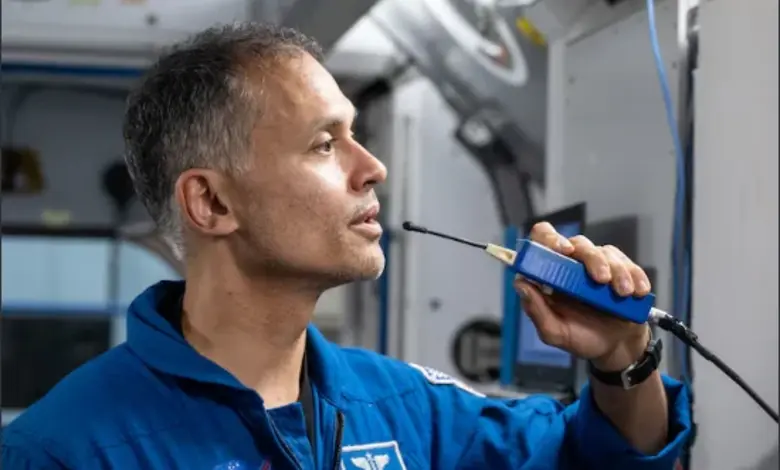
Medical checkups are not as simple in space as they are on Earth. With no gravity and no doctor physically present beside the astronauts, even a basic health check requires special equipment, training and support from the ground.
NASA astronaut Anil Menon recently showed how medical experiments and health checks are carried out aboard the International Space Station (ISS). Menon, who is also an emergency medicine physician, is currently part of Expedition 75 and has been involved in several health-related studies in space.
One of the important experiments involves checking the astronauts’ veins and blood flow. Menon and other crew members undergo regular vein scans using the Ultrasound 3 device. During the experiment, an astronaut operates the ultrasound machine while doctors on Earth guide them in real time.
The process helps scientists understand how weightlessness affects the human body. On Earth, gravity plays an important role in the movement of blood. But in space, the body reacts differently because there is very little gravity.
In a recent experiment, astronaut Jessica Meir operated the ultrasound device while Menon and other crew members had their veins scanned. Doctors on Earth guided Meir during the process and observed the scans remotely. The information collected from these experiments could help scientists understand the health problems astronauts may face during long missions.
ALSO READ: From Earth to Orbit: The Extraordinary Journey of Dr. Anil Menon
Menon is also working on experiments that could make medical care easier during future space missions. NASA said he will perform ultrasound using augmented reality and artificial intelligence methods. The aim is to reduce the need for medical support from Earth when astronauts travel farther into space.
This becomes especially important for future missions to the Moon and Mars. During such missions, astronauts may be too far from Earth for doctors to guide every medical procedure in real time.
Menon’s work also includes studying blood flow, blood composition and the structure of astronauts’ veins in microgravity. He is also involved in research on bioprinting blood-vessel-like structures in space. These experiments could help scientists better understand ageing and develop new medical treatments.
For Menon, the mission is not only about exploring space. His medical background allows him to study how the human body changes in space and how astronauts can remain healthy during longer missions.
As space missions become longer and humans prepare to travel farther from Earth, these experiments could become an important part of keeping astronauts safe. What happens to the human body in space today could help doctors prepare for the challenges of tomorrow’s Moon and Mars missions.
-
-
-

-