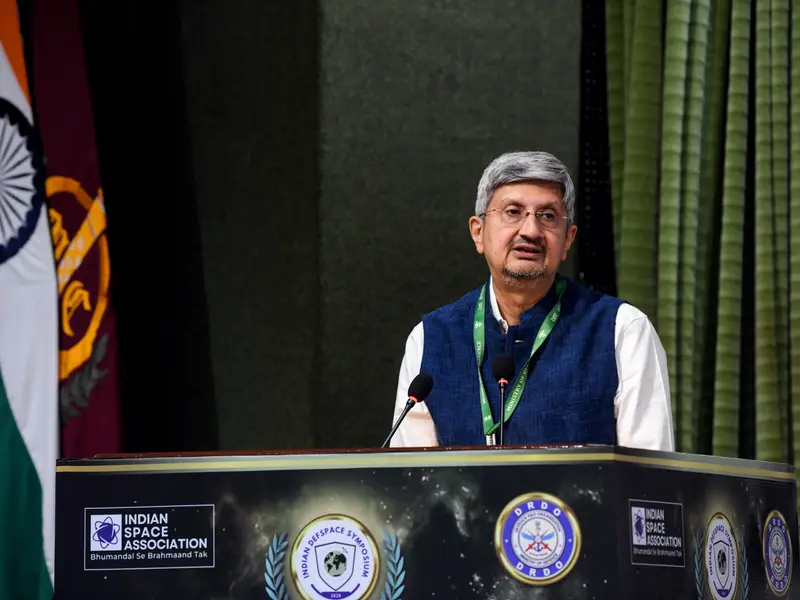
Space has become the defining domain of future warfare, and India must urgently close the gap with rivals whose space programmes are expanding at an alarming pace that was the clear warning from Defence Research and Development Organisation Chairman Samir V Kamat on Thursday.
Speaking at the 4th Indian DefSpace Symposium at Manekshaw Centre on the theme of “Strengthening India’s Defence and Space Industry Synergy,” Kamat called for a “whole-of-nation” approach to accelerate India’s military space capabilities, describing the challenge ahead as “Herculean” without significantly greater investment and collaboration.
DRDO’s Expanding Military Space Mandate
While the Indian Space Research Organisation continues to lead India’s civilian space programme, DRDO has been tasked with developing military space capabilities following the establishment of the Defence Space Agency. Kamat acknowledged that this remains a smaller part of DRDO’s current mandate but noted it is growing rapidly. “It needs to grow much more if we have to keep pace with our rivals,” he said.
To accelerate progress, DRDO is increasingly partnering with startups, MSMEs, and academic institutions, and has set up Centres of Excellence in select establishments with space as a key priority area.
“There is a lot of interest among academia and startups to contribute to the defence part of the space programme,” Kamat said, expressing confidence that India would develop the necessary sovereign capabilities in critical technologies in the years ahead.
Key Areas of Focus
DRDO is currently concentrating on several priority domains: strengthening space situational awareness to protect India’s orbital assets, enhancing the military-grade restricted service of NavIC, advancing space-based surveillance and imaging radar technologies, and developing early missile launch detection systems a capability also emphasised by Air Chief Marshal Bhaduriya.
Kamat noted that while some space technologies can still be sourced from other nations, several critical areas remain restricted and require indigenous development.
R&D Investment Remains Insufficient
Kamat pointed to a significant structural gap in India’s research funding. India currently allocates just 0.65 per cent of GDP to R&D, with only 5 per cent of the defence budget devoted to it.
“We definitely need to scale this up if we have to catch up with our rivals,” he said, stressing that closer integration between civilian and military sectors particularly in overlapping fields such as imaging radar would be essential to bridging that gap.
-

-

-

-