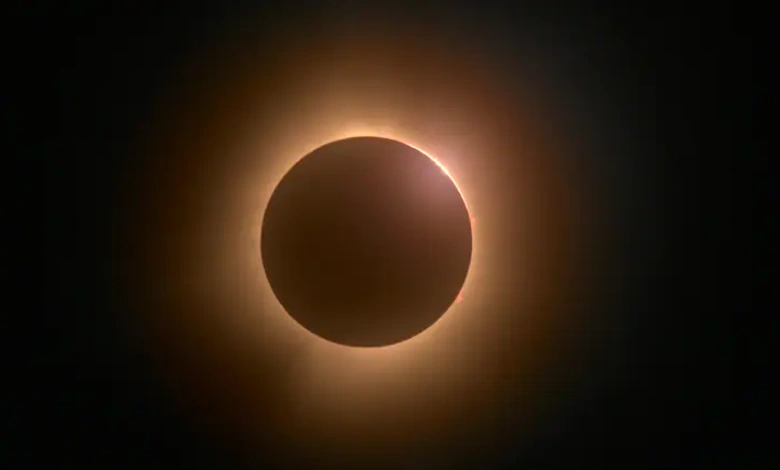
The opening solar eclipse of 2026—an annular “ring of fire” event—will unfold on February 17, but viewers in India and most of the Northern Hemisphere will see nothing of this rare celestial display.
An annular solar eclipse occurs when the Moon, at a point farther from Earth in its orbit, aligns between our planet and the Sun without fully covering the solar disk. This leaves a vivid ring of sunlight visible around the Moon’s silhouette, producing the characteristic fiery halo.
NASA confirms that the full annular phase will be visible solely along a narrow path across Antarctica. The corridor of annularity extends approximately 4,282 kilometers in length and widens to a maximum of about 616 kilometers. The Moon’s antumbral shadow will race across Earth’s surface in less than an hour, with the annular phase running from 11:42 to 12:41 UTC (5:12 p.m. to 6:11 p.m. IST).
Among the few spots equipped to host observers are Antarctica’s Concordia Research Station—a joint French-Italian base—where the ring will persist for about 2 minutes and 1 second starting at 11:46 UTC (5:16 p.m. IST), and Russia’s Mirny Station, offering roughly 1 minute and 52 seconds of annularity from 12:07 UTC (5:37 p.m. IST). These isolated outposts accommodate only small teams of researchers and lack tourist facilities, as highlighted by eclipse specialist Jay Anderson on Eclipsophile.com, meaning the phenomenon will likely be witnessed by very few people.
Partial eclipse stages will appear in southern portions of South America (including sections of Argentina and Chile), southern Africa, and wide swaths of the Pacific, Atlantic, and Indian Oceans. Outside the precise annular path over Antarctica, however, no ring of fire will form anywhere.
For India, the eclipse remains entirely invisible. The event takes place in the Southern Hemisphere during a time when the Sun lies below the horizon or too low for northern locations, rendering it undetectable across the country and much of the globe.
ALSO READ : The Fish That Swam to Fame: Hyderabad’s NFDB Headquarters Hits Global Weird Buildings Radar
Space.com notes that the maximum duration of the annular phase reaches up to 2 minutes and 20 seconds. Wherever partial phases might be glimpsed, safety is paramount: specialists insist on using ISO-certified eclipse glasses throughout the event. Direct viewing of the Sun without adequate protection—even amid annularity—risks severe and permanent eye injury.
This annular eclipse kicks off the year’s solar phenomena, with a total solar eclipse slated for August 12, 2026, visible from regions including Greenland, Iceland, Spain, and parts of Russia and Portugal.
-

-

-

-