
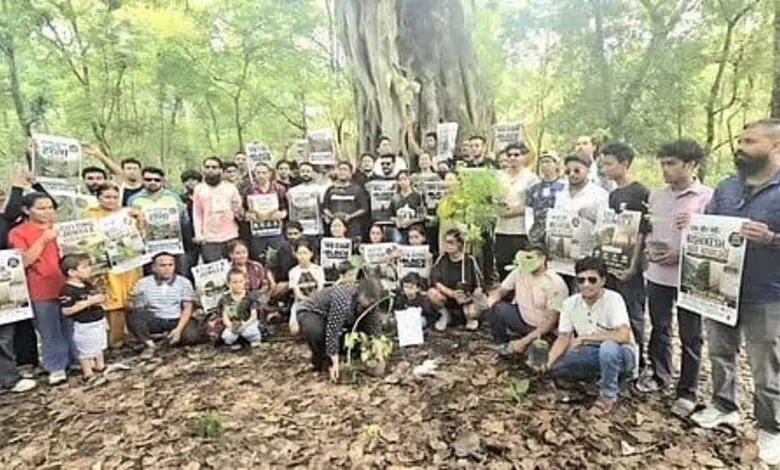
Dehradun: A wave of public protests has prompted the Uttarakhand government to halt the felling of trees for the proposed Rishikesh Bhaniyawala highway widening project, marking a significant pause in one of the state’s most debated infrastructure plans.
Chief Minister Pushkar Singh Dhami announced that no more trees will be cut until the government holds detailed discussions with local residents, environmental experts, elected representatives and other stakeholders. The decision came after days of demonstrations that drew students, activists, retired officials and ordinary citizens, all united by concerns over the impact of the project on the region’s forests.
What began as scattered protests soon grew into a larger environmental movement. People gathered along the highway carrying placards, forming human chains and hugging trees, echoing the spirit of Uttarakhand’s historic Chipko movement. For many residents, the issue is not about opposing development but about ensuring that it does not come at the cost of the state’s natural heritage.
The proposed highway expansion is intended to ease traffic congestion and improve connectivity between Dehradun and Rishikesh, a route that witnesses heavy movement throughout the year, particularly during the Char Dham Yatra and the peak tourist season. Authorities have maintained that the project is essential for reducing travel time and improving road safety.




However, the scale of tree felling became the project’s biggest flashpoint. Environmental groups claim that more than 3,000 trees are likely to be affected, while some estimates place the number even higher when all phases of the project are considered. The stretch also passes through an ecologically sensitive zone that serves as an important wildlife corridor, especially for elephants moving through the Rajaji landscape.
Although the project includes mitigation measures such as an elephant underpass and wildlife crossings, conservationists argue that these cannot fully compensate for the loss of mature forests. They have urged the government to explore alternative alignments or engineering solutions that would reduce the need for large scale tree cutting.
The protests gathered momentum over the past week, with many residents observing a symbolic “Black Harela” instead of the traditional Harela festival, which celebrates nature and tree plantation. The gesture reflected growing public frustration and underscored the emotional connection many people in Uttarakhand have with their forests.
Earlier, tree felling had resumed after legal hurdles were cleared, with work progressing under police security. The renewed activity triggered fresh demonstrations, with protesters insisting that the environmental costs of the project deserved wider public debate before irreversible decisions were taken.
Responding to the growing outrage, the Chief Minister said development and environmental conservation must go hand in hand. He directed officials to suspend the tree felling exercise and begin fresh consultations to find a balanced way forward. His assurance has been welcomed by protesters, though many have stressed that they expect more than a temporary pause.
Environmentalists say the suspension offers an opportunity to revisit the project and examine whether the same connectivity goals can be achieved with fewer ecological consequences. They argue that preserving Uttarakhand’s forests is not only crucial for biodiversity but also for protecting water sources, maintaining ecological balance and safeguarding the state’s long term environmental health.
For now, chainsaws have fallen silent along the Rishikesh Bhaniyawala stretch. Whether the pause results in changes to the project or simply delays it will depend on the discussions that follow. But one thing is clear the public’s voice has become impossible to ignore, and the debate over balancing development with environmental protection is far from over.
ALSO READ: Uttarakhand’s Road Expansion Plan Sparks Outrage As Thousands Of Trees Face the Axe