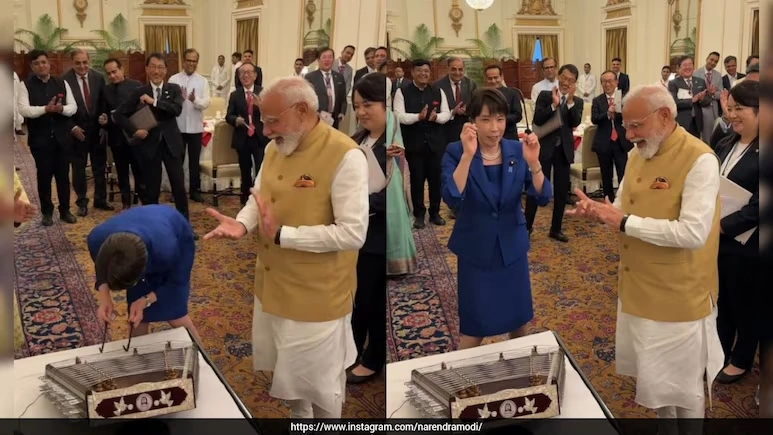
During her official visit to India, Japanese Prime Minister Sanae Takaichi took part in a memorable cultural exchange, attempting to play the traditional Indian string instrument known as the santoor. The lighthearted moment, which unfolded in New Delhi alongside Prime Minister Narendra Modi, has captured public imagination and spread rapidly across social media platforms.
A video recording of the interaction quickly gained traction online, drawing nearly 23 million views. Prime Minister Modi shared the clip on social media, highlighting Takaichi’s effort with a caption noting her engagement with Indian music. Viewers responded enthusiastically, praising the display of cultural appreciation and the evident rapport between the two leaders. Comments ranged from simple expressions of delight to observations about the friendly personal dynamic, with some likening it to a sibling-like bond.
This cultural gesture aligns with the broader context of the leaders’ meeting. In remarks at a joint press briefing following the India-Japan Annual Summit, Prime Minister Modi welcomed Takaichi as his “younger sister” on her first visit to India for the summit. He described her as Japan’s first woman prime minister, a visionary and popular figure, and noted her roots in Nara Prefecture, a region with historical Buddhist connections to India.
A post shared by Mumbai Samachar English (@mumbaisamacharenglish)
Takaichi arrived in India for a three-day official visit from July 1 to July 3 at the invitation of Prime Minister Modi. The centerpiece of her trip was participation in the 16th India-Japan Annual Summit. During the discussions, both leaders examined the comprehensive spectrum of bilateral ties and exchanged views on regional and international matters of shared concern.
The santoor session stands out as a spontaneous highlight amid formal diplomatic engagements, illustrating how personal interactions can complement high-level talks. The instrument, with its rich heritage in Indian classical music, provided a bridge between the two nations’ cultural traditions. Takaichi’s willingness to engage with it reflected openness and respect for Indian customs, adding a human touch to the strengthening partnership between India and Japan.
Such moments often resonate deeply with the public, humanizing leaders and underscoring the value of cultural diplomacy. The viral response underscores widespread appreciation for initiatives that foster closer people-to-people connections alongside strategic cooperation. As the two countries continue to build on their multifaceted relationship, episodes like this reinforce the warmth and mutual goodwill that define their ties.
-

-

-
-