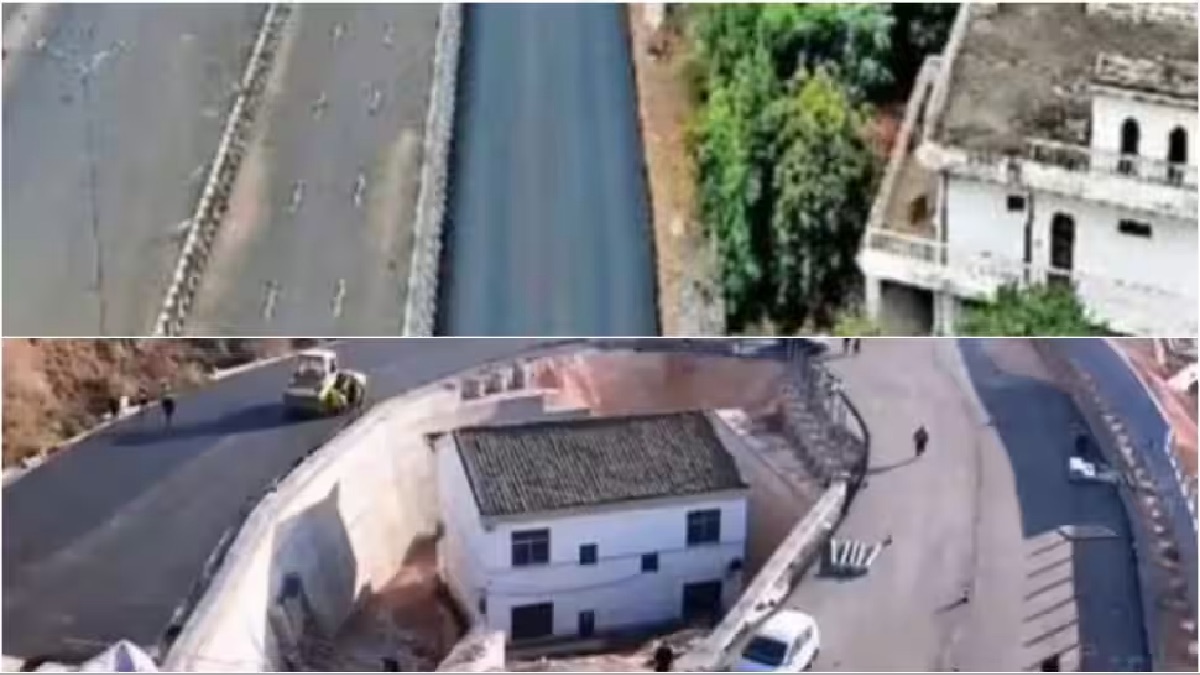
When Prime Minister Narendra Modi inaugurated the Delhi–Dehradun Expressway on April 14, the 213-km corridor was largely ready except for one problem. A two-storey house named Swabhiman (self-respect) sits squarely in the path of a service road in Mandola village, Ghaziabad, Uttar Pradesh, blocked on all four sides, its owner in Noida, its security guard cleaning it every day. The parallels with China’s so-called “nail houses” are hard to miss.
China’s Nail House — and What Happened Next
In 2025, tofu vendor Ye Yushou refused to let the Chinese government acquire his property in Jinxi County, Jiangxi province, for the construction of the G206 highway. Authorities completed the highway anyway building the road around his house. The structure became the latest in a long line of Chinese “nail houses,” a term for properties whose owners resist government acquisition.
The story did not end well for Yushou. He had turned down a compensation offer of 1.6 million yuan (roughly $220,000) along with alternative housing, holding out instead for 2 million yuan and three homesteads. According to the South China Morning Post, he later admitted the decision felt like “losing a gamble.” The highway went around him. Compensation negotiations closed. His house now sits isolated in the middle of a busy road, surrounded by traffic noise and disruption, with a special access route constructed by the government as the only concession.
The House That Stopped a Service Road
Back in Mandola village, Swabhiman tells a different but eerily similar story. The land dispute here goes back to 1998, when the late Dr Veersen Saroha challenged the Uttar Pradesh Housing Board’s acquisition of his land for the Mandola Housing Scheme in the Allahabad High Court. The authorities had moved to acquire 2,614 acres across six villages, offering Rs 1,100 per square metre. Saroha rejected the offer and went to court seeking higher compensation.
The housing scheme was never completed. In 2020, NHAI launched the Delhi–Dehradun Expressway project and needed that same land parcel specifically for a service road allowing vehicles coming from Dehradun to exit at Mandola toward Panchlok near Loni.
The land is now owned by the late Saroha’s grandson, Lakshyaveer Saroha, according to a report in The Indian Express. With demolition threats looming, Lakshyaveer filed a petition in the Supreme Court in 2024 while the original dispute remained pending in the Allahabad High Court. The Supreme Court directed that the status quo be maintained no demolition, no further construction and asked the High Court to fast-track the hearing.
On the Ground at Swabhiman
Shivang Shukla of India Today Group’s Mo visited the site and found a two-storey house spread across nearly 1,600 square metres. A security guard appeared after Shukla called out from outside. Asked about the owner, the guard said simply: “Owner stays in Noida.”
The family’s position is straightforward. Speaking to Mo, the landowner’s mother said: “Our demand is clear we need the authorities to pay compensation according to current land prices, else let them forget about our land.”
The guard told The Indian Express: “The house always remains empty, and I clean it every day.” He added that the traffic noise since the expressway began operations has become difficult to manage.
An NHAI official supervising the project told The Times of India that the problem had been known since the corridor opened for trial runs. “The ramp needs to be constructed at the earliest, but since it is caught in litigation, there is nothing we can do. We have erected crash barriers,” the official was quoted as saying. The last hearing was in March at the Allahabad High Court, which set a date for the next one.
The Expressway by the Numbers
The Delhi–Dehradun Expressway cuts travel time between the two cities from around six hours to just two to two-and-a-half hours. The project cost an estimated Rs 12,000–13,000 crore and features a six-lane, access-controlled design with a 100 kmph speed limit, 14 wayside amenities, multiple bridges, interchanges, and rail overbridges. Everything is in place except the service road at Mandola. What becomes of Swabhiman now depends on the courts.
-
-

-

-