
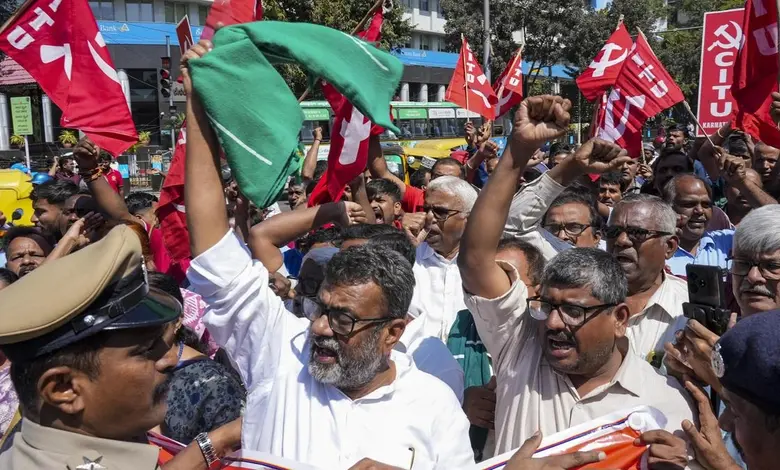
New Delhi — Central trade unions reported that more than 30 crore workers, farmers, agricultural labourers, and employees from various sectors took part in a nationwide general strike on Thursday, marking one of the largest such mobilisations in India’s independent history.
The strike was jointly organised by central trade unions (CTUs) and the Samyukt Kisan Morcha (SKM), focusing opposition on the four Labour Codes and free trade agreements (FTAs) recently pursued with the United States, the European Union, and the United Kingdom, as reported by The Hindu.
Union leaders stated that actions and large gatherings occurred in over 600 districts nationwide. Significant participation was noted in mining, manufacturing, and service sectors, including formal and informal workers. Employees in many industrial zones, including multinational companies, joined demonstrations and marches. Defence sector workers staged protests with a one-hour work stoppage in solidarity, while railway unions carried out supportive actions.
The unions highlighted that government efforts to suppress democratic protests had only intensified anger among workers and farmers.



The SKM praised the collaboration between workers and peasants, describing it as a cornerstone of resistance against corporate-oriented policies of the BJP-led NDA government under Prime Minister Narendra Modi. The farmers’ body pointed to widespread discontent over FTAs, the Viksit Bharat-Guarantee for Rozgar and Ajeevika Mission (Gramin) Act (VB GRAMG Act), the Electricity (Amendment) Bill, the Draft Seeds Bill, the Insurance Act, the Sustainable Harnessing and Advancement of Nuclear Energy for Transforming India (SHANTI) Act, provisions in the Union Budget 2026-27, and the lack of minimum support price implementation based on the MS Swaminathan Commission formula with assured procurement. They also criticised the absence of comprehensive loan waivers to address farmer indebtedness and ongoing peasant suicides.
ALSO READ : Protests Erupt Over Netflix Film ‘Ghooskhor Pandat’
The SKM announced its national council would convene on February 24 in Kurukshetra, Haryana, to plan future steps.
Trade Union Coordination Centre (TUCC) leader G. Devarajan described the response as unprecedented, underscoring the unity, strength, and democratic commitment of India’s working masses in opposing what unions term anti-worker, anti-farmer, and pro-corporate government measures.