
The U.S. Department of Justice has concluded its court-ordered disclosure under the Epstein Files Transparency Act by publishing more than 3.5 million pages of records tied to convicted sex offender Jeffrey Epstein. The release, finalized in early February 2026, includes over 2,000 videos, 180,000 images, and extensive correspondence, financial documents, and investigative materials related to Epstein’s life, crimes, and 2019 death in federal custody.
Among the many prominent figures mentioned in the files are Elon Musk, Deepak Chopra, former Obama White House counsel Kathryn Ruemmler, former Treasury Secretary Lawrence Summers, former Trump adviser Steve Bannon, Epstein’s brother Mark Epstein, his accountant Richard Kahn, longtime attorney Darren Indyke, and his final girlfriend Karyna Shuliak. Earlier trust documents also referenced French modeling agent Jean-Luc Brunel, who died by suicide in a Paris jail in 2020 while facing rape and trafficking accusations.
The documents detail Epstein’s last will and amended trust, executed shortly before his death, which distributed nearly $600 million across 44 beneficiaries. Significant portions went to Indyke, Kahn, Shuliak, Ghislaine Maxwell, and Mark Epstein. A psychiatric evaluation conducted after Epstein’s suicide describes him as outwardly charismatic but socially isolated despite his wide circle of high-profile acquaintances.
Deputy Attorney General Todd Blanche told CNN’s State of the Union that a comprehensive review completed in July found no basis for new criminal prosecutions. He emphasized that the full public release allows independent verification of that conclusion.




ALSO READ : India Dismisses Reference To PM Modi’s Israel Visit In Epstein Files As ‘Trashy Ruminations’
Ghislaine Maxwell remains incarcerated, serving a 20-year federal sentence for her conviction in the sexual exploitation and trafficking of minors connected to Epstein’s activities. Epstein was previously convicted of sex crimes in Florida in 2008 and died by suicide on August 10, 2019, while awaiting trial on federal sex-trafficking charges following his July 2019 arrest.
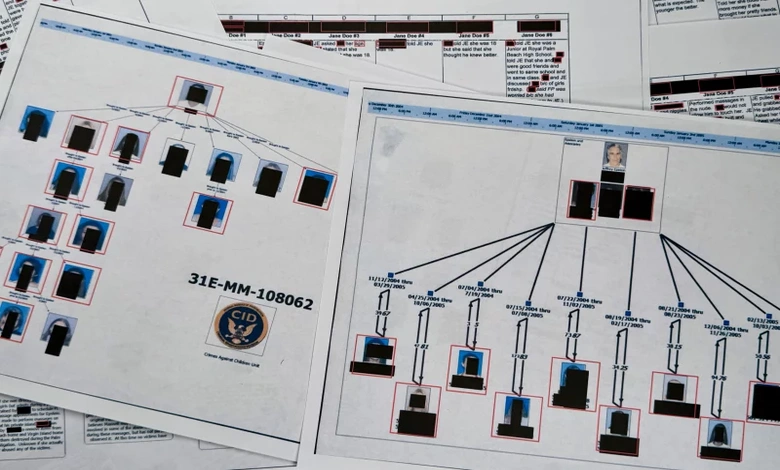
The release has drawn sharp criticism for inconsistent and at times inadequate redactions. NPR’s examination of the files found multiple instances in which names of known victims—or previously unidentified individuals—were left visible. Some images had faces obscured while others did not, and a recurring PowerPoint timeline of Epstein and Maxwell’s cases showed varying levels of redaction across versions.
The Justice Department, which assigned 500 personnel to review the materials, acknowledged that roughly 0.1% of pages—more than 3,000—contained unredacted victim-identifying information. Affected documents are being withdrawn and reissued with corrected redactions.
Survivor Annie Farmer, who testified against both Epstein and Maxwell, told NPR’s All Things Considered that the redaction failures were difficult to understand given the department’s prolonged access to victim information and appeared potentially deliberate rather than merely hasty.
A federal judge in New York has scheduled a February 5, 2026 hearing to consider a motion from victims’ attorneys seeking a temporary shutdown of the dedicated Justice Department website until all sensitive victim details are properly protected.
The files also reference Epstein’s childhood attendance at the Interlochen Center for the Arts in 1967 and subsequent donations totaling nearly $400,000 between 1990 and 2003. The nonprofit stated that internal reviews found no allegations or complaints of abuse on its property linked to Epstein.
While the documents provide extensive insight into Epstein’s financial arrangements and far-reaching social connections, they have not surfaced evidence that would support fresh criminal cases against named associates, leaving broader questions of accountability open even as privacy protections for survivors remain a pressing concern.