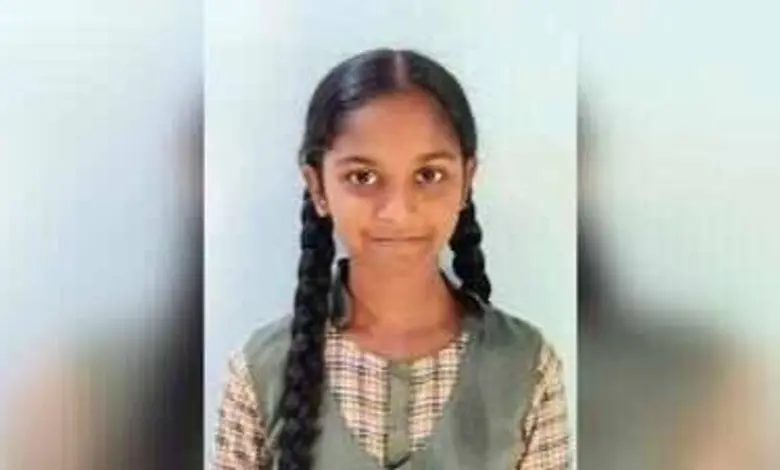
Amaravati: What began as a science enthusiast’s dream in a government school classroom has turned into an achievement that is drawing attention across the country. Fourteen year old Kandula Jessie, the daughter of a carpenter from Andhra Pradesh, has been selected for Mission ShakthiSAT, the world’s first global all girls lunar CubeSat mission.
A Class 10 student at Zilla Parishad Girls High School (ZPGHS) in Dhavaleswaram, Jessie is among just 20 students chosen from India after a highly competitive selection process that attracted nearly 12,000 applications from girls across 108 countries. She is also the only student from Andhra Pradesh to make it to the Indian team.
For Jessie’s family, the selection is more than an academic milestone. It is proof that determination, the right guidance and access to opportunities can help students from even the most modest backgrounds compete on an international stage.
Her interest in science was spotted early by her Physical Science teacher and Atal Tinkering Lab coordinator, Manimala, who encouraged her to apply for the programme. Jessie even persuaded eight of her classmates to register. Although they initially missed part of the online coursework, her teacher reached out to the organisers and secured another opportunity for the students, allowing Jessie to stay in the race.
The programme is far from easy. Participants are required to complete around 550 online sessions spread across 21 modules, covering topics such as satellite systems, propulsion, thermodynamics and other areas of space science that are well beyond the Class 10 curriculum. Jessie has been balancing these demanding lessons with her board exam preparation and has already completed more than half of the course.
The final selection involved multiple stages, including online assessments, a one hour interview with scientists and programme officials, and a short presentation explaining the significance of Mission ShakthiSAT and the importance of encouraging more girls to pursue careers in science and technology. Since the interview was conducted entirely in English, Jessie spent weeks improving her communication skills with the help of her teachers.
Speaking after her selection, Jessie said she had never imagined that a student from a government school would get the opportunity to be part of an international lunar mission. She credited her teachers for standing by her throughout the process and said she now hopes to build a career in space research, with a dream of working at the Indian Space Research Organisation (ISRO).
Her mother, Aruna, said the family had moved Jessie from a private school to a government school because of financial constraints. Watching her daughter interact confidently with scientists from different countries, she said, was a moment of immense pride for the family.
Jessie will now travel to New Delhi on August 23 for the next phase of the programme, where participants will receive hands on training and take part in National Space Day events. The students will work with scientists on satellite design, payload integration and mission planning before the CubeSat is expected to be launched from Sriharikota on October 11.
Jessie’s achievement has been widely welcomed by educators and public representatives, who say her success sends a strong message that talent is not limited by financial circumstances or the type of school a student attends. At a time when India is expanding its footprint in space exploration, her journey also highlights the growing efforts to encourage more girls to pursue careers in science, technology, engineering and mathematics (STEM).
-

-

-

-