
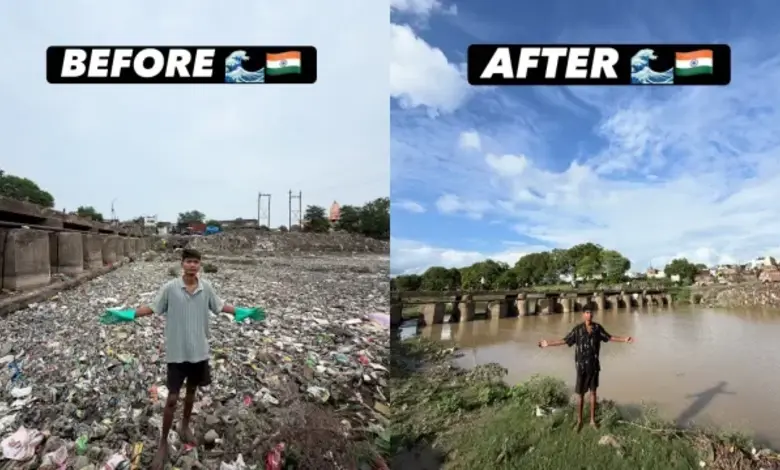
Rajgarh: It takes months of relentless physical labor to restore a natural water body, but it takes merely a few thoughtless moments for it to turn back into a garbage dump. This harsh reality struck home once again in Madhya Pradesh’s Rajgarh district, where the Ajnar River, recently cleaned through months of grueling solo effort, was once again found choked with plastic bags and waste.
The disheartening sight was brought to light by Surendra Singh Choudhary, widely known on social media as “Bittu Tabahi.” Choudhary had previously spent eight months clearing tonnes of garbage from the riverbed, working entirely on his own without the backing of specialized equipment or corporate machinery. His initial mission was a testament to individual dedication, transforming a polluted stretch of water back into a flowing river.
However, a recent visit revealed that the banks and the water had been littered once again. Rather than walking away in despair, Choudhary chose to return to the task. Even though he is not a strong swimmer, he stepped back into the river, collecting the discarded plastic bag by bag.
ALSO READ: Women Journalists’ Assault Allegations Spark Govt Response On Media Credentials

Sharing his disappointment on social media, he wrote that he had never imagined his eight months of relentless toil could be undone so swiftly. Beyond showcasing the clean-up, he reached out to his followers, asking for practical suggestions and efficient methods to clear the recurring garbage from the Ajnar River permanently.
The viral video has since ignited a broader online conversation regarding public responsibility and the ongoing challenge of waste management in water bodies. While many social media users praised Choudhary for his unwavering commitment and dubbed him a hero, the sentiment quickly shifted toward frustration over a recurring societal habit.
Commentators began questioning the underlying civic sense that allows individuals to treat natural resources as waste receptacles. Several users pointed out a systemic cultural flaw, noting that while it is easy to shift blame onto local authorities or governments, the root of the problem often lies within individual actions. Questions are now being raised: Why do we expect grassroots volunteers to bear the brunt of environmental upkeep? How many times must individuals clean up before public accountability steps in? And fundamentally, do our natural water systems stand a chance if community habits refuse to evolve?
As Choudhary continues his lonely battle in the waters of the Ajnar River, his efforts serve as both an inspiring act of conservation and a sobering reminder. The question is no longer just about how to clear the plastic out of the river, but how to clear the apathy out of our communities before the next clean-up effort goes to waste.