
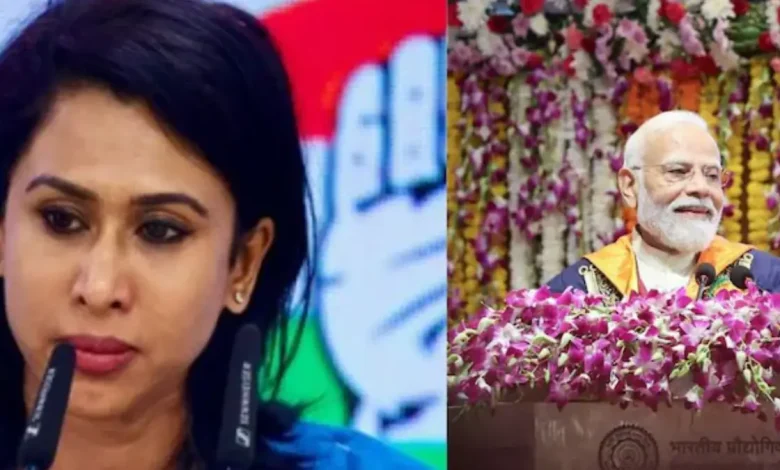
New Delhi : A controversy over a recitation at IIT Delhi’s 57th Convocation has sparked a wider debate over religion and secularism in educational spaces. Congress spokesperson Shama Mohamed questioned why the Gayatri Mantra was played at the academic ceremony. The distinction is central to the controversy. While Mohamed argues that academic institutions should remain free from religious slogans and chants, Mehta says her criticism is based on a factual error.
The exchange has shifted the focus from the broader question of religion in educational institutions to a more basic one: what exactly was recited at the IIT Delhi ceremony? Mohamed questioned why the Gayatri Mantra would be played at an IIT convocation, while making it clear that she personally has no objection to hearing it. “My cook plays the Gayatri Mantra every day when he enters my kitchen, and I listen to it every day and like it,” she said.“But my question is: Why was the Gayatri Mantra played at an IIT convocation? It wasn’t a religious event.
Mehta’s response is striking because he does not simply reject Mohamed’s secularism argument. Instead, he begins with what he considers a more fundamental problem: the recitation has been wrongly identified. That means the controversy cannot simply be reduced to a political disagreement over whether religious material should be allowed at IITs. Before that debate can be settled, the actual content of the recitation has to be correctly identified.
IIT Delhi held its 57th Convocation on August 8, with more than 3,000 students and 587 PhD scholars present. Prime Minister Narendra Modi addressed the graduating students and urged them to remain curious, question accepted ideas and have the courage to find solutions. The Prime Minister’s address focused overwhelmingly on education, research, technology, innovation and the role of young graduates in India’s future.



There is a legitimate debate over whether religious or traditional invocations should be part of ceremonies at public educational institutions. Mohamed’s broader argument is that academic spaces should remain free from religious slogans and chants of all faiths. That question can be debated independently. But the debate becomes complicated when the recitation at the centre of it is incorrectly identified. The fact that a verse is in Sanskrit does not automatically make it the Gayatri Mantra; Sanskrit is a language with religious, philosophical, cultural and ceremonial uses.
Read Also : Deadlock With Govt, Jharkhand Students To March Towards Assembly