
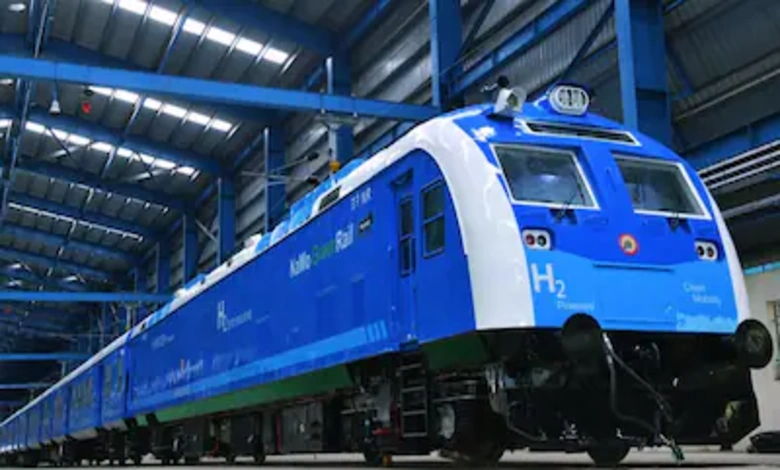
Prime Minister Narendra Modi flagged off India’s inaugural hydrogen-powered train on Friday from Jind railway station in Haryana, marking a significant step in the country’s push toward sustainable transportation. This development positions India among a small group of nations advancing hydrogen fuel cell technology for rail operations, offering a cleaner alternative for routes where full electrification may not be practical.
The pilot project focuses on the Jind-Sonipat corridor, selected to test the viability of hydrogen trains on non-electrified or heritage lines. It supports broader efforts to reduce reliance on diesel through innovative green mobility solutions. The train generates electricity onboard via hydrogen fuel cells rather than drawing power from overhead lines, producing only water vapor as a byproduct.
Route and Schedule Details
The service operates daily with two trains. Train 74010 departs Jind at 7:40 AM and arrives in Sonipat at approximately 9:40 AM, completing the journey in about two hours. On the return, Train 74009 leaves Sonipat at 10:40 AM and reaches Jind around 1:00 PM, taking roughly two hours and 20 minutes.




Intermediate stops include Jind City, Pandu Pindara, Lalit Khera, Bhambeva, Ishapur Kheri, Butana, Khandrai, Gohana, Rabhra, Lath, Mohana Haryana, and Barwasni. The train falls under Northern Railways operations, with primary maintenance based at Jind.
Key Features and Technology
This 10-coach passenger train stands out globally as the longest hydrogen-powered train in operation or testing, compared to shorter 2-3 coach models elsewhere. It features a design speed of 110 kmph but will run at a maximum of 75 kmph on this route. With capacity for 2,600 passengers and a powerful 3,200 horsepower propulsion system, it ranks among the most capable hydrogen trainsets currently active.
The trainset consists of two hydrogen-powered driving cars and eight trailer coaches. Each power car integrates fuel cells, lithium iron phosphate batteries, and hydrogen storage cylinders. Hydrogen reacts with oxygen from the air in Proton Exchange Membrane fuel cells to produce electricity that drives the motors. This process emits no carbon or smoke, only water vapor and heat.
An indigenous hydrogen storage and refueling facility at Jind supports operations, complete with compression systems, safety features like leak and flame detectors, and backup equipment. The entire train was designed, engineered, and integrated domestically using local technology.
Other countries such as Germany, Japan, China, and the United States have been exploring or running similar systems. This launch provides valuable insights for expanding hydrogen rail applications across India’s network, which has already electrified over 99% of its broad gauge lines.