
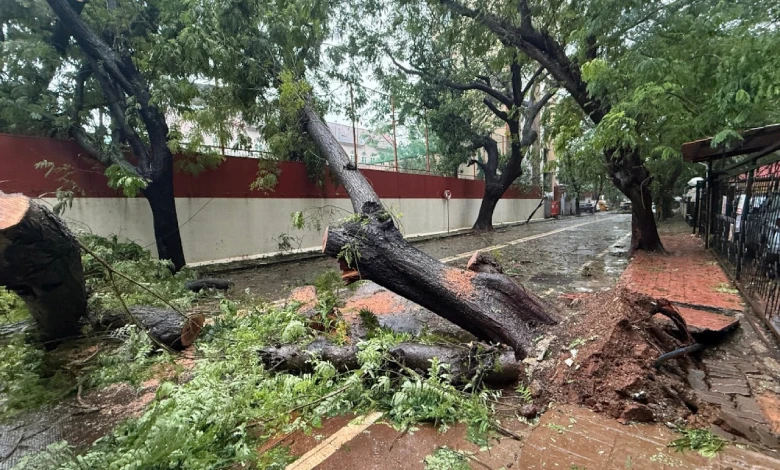
Brihanmumbai Municipal Corporation (BMC) has planned to form a seven or eight-person committee of experts, including arborists, horticulturists, and landscape and urban designers, to improve footpath designs, favor tree survival, and maximize use of open spaces to increase urban greening, following the collapse of 827 trees in just two weeks this monsoon.
The BMC will shortly begin negotiations with the experts whose names have been shortlisted for the panel. The panel will perform research and inspections, offer expert insights, and recommend long-term solutions on an as-needed basis.
Mumbai has 28.7 lakh trees, according to the 2018 tree census. There are about two lakh of these on walkways, and some of them are older than fifty or sixty years. They are of the kinds that have intricate root systems and grow tall, huge, and wide. The civic authority prunes about one lakh trees on walkways each year before to the start of the rainy season.
Urban trees are more prone to collapsing due to variables including high wind speed and heavy rain that cause water retention, according to statistics from the BMC. According to an official, “thus they are trimmed.” “We aim to investigate the possibility of controlling tree roots’ height above ground over a long period of time by scientifically training their growth. A senior civic official stated, “We will investigate this with the assistance of experts.”


According to Stalin Dayanand, director of the environmental organization Vanashakti, which is based in Mumbai, the healthy growth of roots depends on the availability of continuous earth or mud. After conducting a thorough 15-month study of Mumbai’s public trees, we presented a report to BMC in 2015, but the local body has not taken any action. Making a 6×6-foot dirt patch at the base of each tree was one of our recommendations. In Mumbai, this is not as easy as it seems. Many of our trees are split between the road and the sidewalk. All utility conduits are located beneath the walkway, while stormwater drain chambers on the carriageway’s edge prevent constant access to the ground.
Also Read – Just 6 Months After Inauguration, Roof Collapses At Mumbai Civic Body’s New Office