
India and Netherlands Upgrade Bilateral Ties to Strategic Partnership Level
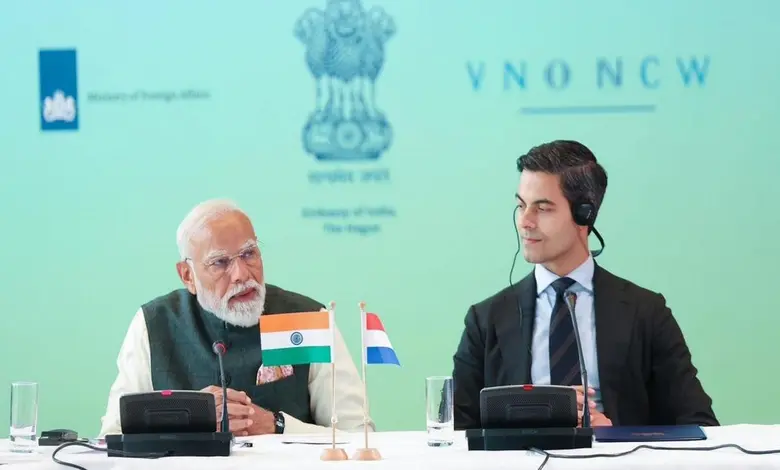
The Hague: Prime Minister Narendra Modi announced on May 16, 2026, that India and the Netherlands have agreed to elevate their bilateral relationship to a strategic partnership, following detailed discussions with Dutch Prime Minister Rob Jetten.
The decision came amid evolving global geopolitics as part of Mr. Modi’s two-day visit to The Hague, the second leg of a broader four- or five-nation European tour focused on strengthening key partnerships. The two sides also signed multiple agreements to deepen cooperation across various sectors.
In his opening remarks during the talks, Mr. Modi noted substantial advancement in India-Netherlands relations over the past decade. He described the Netherlands as one of India’s most significant partners in Europe, citing deep historical and people-to-people connections. “Democratic values, market economy and responsible behavior are part of our common approach,” he said, highlighting ongoing collaboration in water management, healthcare, and education that has benefited citizens in both countries.
Bilateral trade reached $27.8 billion in 2024-25, making the Netherlands one of India’s top trading destinations in Europe. It also ranks as India’s fourth-largest investor, with cumulative foreign direct investment totaling $55.6 billion.




Mr. Modi emphasised the need to combine Dutch expertise with India’s “speed and skill” to expand cooperation in innovation, investment, sustainability, and defence. “Under this common vision, we are taking India-Netherlands relations to the level of strategic partnership,” he stated. Dutch Prime Minister Jetten echoed the sentiment, formally announcing the upgrade.
ALSO READ : UAE Announces $5-Billion Investment In India Amid PM Modi Visit
Prior to the bilateral meeting, the two leaders engaged with chief executives of major Dutch firms in sectors including energy, ports, health, agriculture, trade, and technology. Mr. Modi invited Dutch companies to invest in India, spotlighting opportunities in maritime, renewable energy, digital technologies, semiconductors, artificial intelligence, and healthcare.
He pointed to ongoing reforms aimed at improving ease of doing business, including updates to taxation, labour codes, and governance. “Manufacturing in India is becoming very cost-effective,” Mr. Modi said, adding that the services sector has emerged as a driver of efficiency and innovation. “We invite all of you to design and innovate in India. There can be no better time for this than today.”
The Prime Minister portrayed India as a symbol of both scale and stability — the world’s fastest-growing major economy with a vast talent pool and unmatched infrastructure development speed. He also referenced 12 years of policy continuity that have opened sectors such as space, mining, and nuclear energy to private investment.
Both Prime Ministers stressed the urgency of advancing the India-EU Free Trade Agreement. The visit included the return of ancient Chola-era Anaimangalam Plates from Leiden University to India, underscoring cultural ties.