
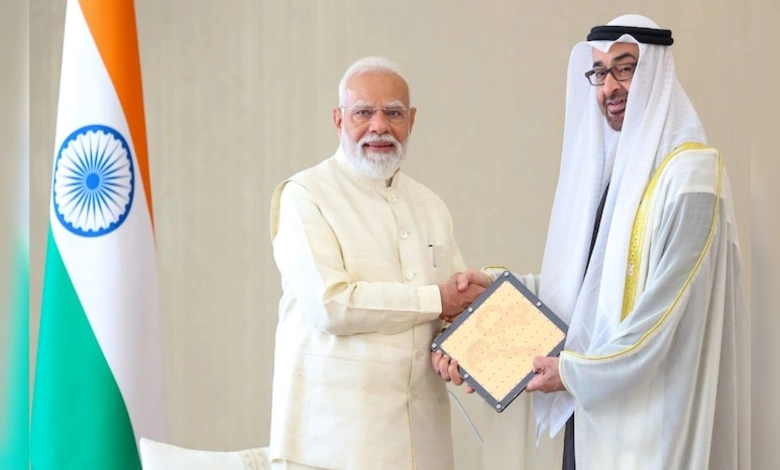
Prime Minister Narendra Modi concluded the first leg of his five-nation tour with an official visit to the United Arab Emirates on Friday, where he engaged in extensive discussions with UAE President His Highness Sheikh Mohammed bin Zayed Al Nahyan in Abu Dhabi. The meetings produced significant outcomes, including a new strategic defence framework, a major investment package worth $5 billion, and several energy cooperation agreements.
Upon arrival, PM Modi received a ceremonial welcome from President Sheikh Mohammed. The leaders held detailed talks focused on advancing the India-UAE Comprehensive Strategic Partnership. Modi reiterated India’s strong condemnation of recent attacks on the UAE and expressed full solidarity with its leadership and people. He also emphasised the importance of maintaining safe and unimpeded navigation through the Strait of Hormuz for regional stability, global energy security, and food security.
Energy collaboration formed a central part of the agenda. The two countries signed a Strategic Collaboration Agreement between Indian Strategic Petroleum Reserves Limited and the Abu Dhabi National Oil Company (ADNOC), increasing UAE participation in India’s Strategic Petroleum Reserves to 30 million barrels. They also agreed to jointly establish strategic gas reserves in India. Additionally, a long-term arrangement for LPG supplies was formalised between Indian Oil Corporation (IOCL) and ADNOC. Both sides recognised the UAE’s consistent role as a key partner in India’s energy needs, covering crude oil, LNG, and LPG, and committed to further initiatives for deeper energy partnership.
In a notable economic highlight, UAE entities announced investments totalling $5 billion in India. Emirates NBD will invest $3 billion in RBL Bank, the Abu Dhabi Investment Authority (ADIA) will commit $1 billion in collaboration with India’s National Infrastructure and Investment Fund (NIIF) for priority infrastructure projects, and the International Holding Company will invest $1 billion in Sammaan Capital. According to the Ministry of External Affairs, these commitments reflect the UAE’s sustained and long-term support for India’s economic growth.
The visit also marked the signing of a Framework for Strategic Defence Partnership, aimed at institutionalising and expanding defence industrial collaboration, innovation in advanced technologies, joint training and exercises, maritime security, cyber defence, and secure information exchange.
Further agreements covered technology and maritime sectors. A term sheet was signed between India’s CDAC and UAE’s G-42 to establish an 8 Exaflop Super Compute Cluster. Two MoUs were concluded involving Cochin Shipyard Limited and Dubai’s Drydocks World for a Ship Repair Cluster at Vadinar and skill development initiatives through a tripartite agreement with the Centre of Excellence in Maritime and Shipbuilding.
The leaders welcomed the operationalisation of the Virtual Trade Corridor via the MAITRI digital platform, which links customs and port authorities to facilitate smoother cargo movement and reduce costs. These developments build on the foundation of the India-UAE Comprehensive Economic Partnership Agreement (CEPA), which has significantly boosted bilateral trade.
PM Modi expressed gratitude for the hospitality extended by President Sheikh Mohammed and invited him to visit India soon. He will now proceed to the Netherlands, Sweden, Norway, and Italy, returning to New Delhi on May 20.