
Didi Down, Stalin Stumbles: How Scams, a Murder and Vijay’s 20-Year Plan Changed Two States Forever
[By Devansh Desai Mumbai Samachar Desk]
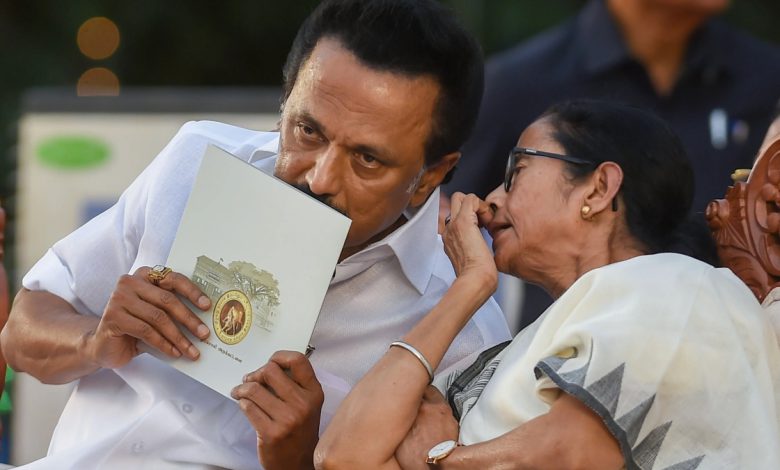
Mamata Banerjee has ruled West Bengal for 15 years. M.K. Stalin has governed Tamil Nadu for five. In the 2026 state elections, both lost their own seats. Banerjee fell in Bhavanipur a constituency she had held as her personal fortress to the BJP, a party that won just four percent of Bengal’s votes in 2011 and held three seats in 2016. Stalin lost to a man who had no political party as recently as 2024. The man’s name is Vijay. He is, by profession, a film star.
Two states, two vastly different stories. But in both cases, the result was the same: incumbents with near-total control over their states were voted out. Here’s how it happened.
THE BENGAL STORY: CASH IN THE CUPBOARD
The crack that split the TMC’s foundation open was visible in July 2022, when ED officers raided the home of Arpita Mukherjee a close associate of Partha Chatterjee, who was then serving as Bengal’s Education Minister and was widely regarded as Mamata Banerjee’s most powerful lieutenant. Behind the clothes in Mukherjee’s cupboard, officers found Rs. 21.9 crore in cash. Both were arrested.
The money, it turned out, was the tip of the iceberg. Chatterjee had allegedly centralised the entire teacher recruitment process determining who got appointment letters and who didn’t, at a price. During Covid, candidates reportedly paid directly and letters were auto-generated. The Calcutta High Court constituted an inquiry committee, found enough evidence to cancel the entire process, and the scam became one of the most-discussed corruption cases in Bengal’s recent history.

Then came August 9, 2024 a date that many believe irreversibly broke Banerjee’s relationship with the women who had voted for her. A 31-year-old junior doctor was raped and murdered inside a seminar room at R.G. Kar Medical College, Kolkata. The Indian Medical Association accused the TMC of trying to destroy evidence. A CBI investigation was launched. TMC MLA Nirmal Ghosh was questioned after the victim’s family accused him of rushing to collect the body.
The streets responded. On August 14, thousands marched across the country well past midnight. Thirteen days later, another rally was met by the Bengal government with tear gas, lathi charges, and water cannons. The optics were brutal: a Chief Minister who had built her career on women’s votes was now directing state force against people mourning a woman’s murder.
Sandeshkhali, a village 100 km from Kolkata, added yet another chapter. ED officers who arrived to question Sheikh Shahjahan a TMC district council member accused in a ration scam were surrounded by a mob of thousands, beaten up, and had their phones snatched. Shahjahan vanished. Bengal Police said they had no idea where he was for 55 days. When he was finally arrested, women from the area spoke up: Shahjahan’s men had flooded their fields with saltwater for years to make land barren and seizable. They had received calls demanding sexual favours. Police stations had refused to register FIRs.
THE ECONOMY: 3,000 KM FOR A DECENT WAGE
The political anger ran alongside quiet economic despair. Infosys had bought 50 acres in Kolkata’s Rajarhat township, planning a software campus like the ones it built in Bengaluru, Pune, and Hyderabad. Banerjee’s government refused to grant it SEZ status not surprising for a politician whose rise was powered by the Singur agitation that drove Ratan Tata’s Nano factory out of Bengal to Gujarat. Infosys waited eight years, then gave up on the SEZ and put in Rs. 100 crore for a single building. Its Bengaluru campus employs 30,000 engineers. Wipro, which had also bought land in Salt Lake for a similar purpose, got the same answer.
The human cost was measurable. According to 2024 estimates, five lakh of Kerala’s 25 lakh migrant workers had come from West Bengal 20% of the total. The reason: daily wages in Murshidabad run between Rs. 200 and Rs. 400. In Kerala, the same work pays up to Rs. 1,000. Bengalis were travelling 3,000 km across the country for work their home state could not provide.
Banerjee’s answer was Lakshmir Bhandar a direct transfer scheme that deposited Rs. 1,500 per month into the accounts of over two crore women by 2026. It was her political trump card. The BJP neutralised it simply by promising to pay more. The card was gone.
THE TAMIL NADU STORY: TWENTY YEARS TO MAKE A SUPERSTAR POLITICIAN
Tamil Nadu’s story should not have been possible. The DMK under Stalin had delivered 16% GDP growth one of the best numbers in the country. Apple’s Foxconn assembly lines are running in the state. And yet Stalin lost his seat. To Vijay.
This did not happen by accident. Vijay born Joseph Vijay Chandrasekhar into a Chennai film family spent twenty years building toward this moment. Tamil Nadu has a well-worn template for star politicians: MGR wrote it, Jayalalithaa refined it. Play the common man on screen, put your face on welfare schemes, turn fan worship into votes. Vijay understood the template and added something neither MGR nor Jayalalithaa had built: a proper ground organisation.
In 2009 fifteen years before he launched TVK, his political party Vijay merged all his fan clubs into a registered body called VMI, headquartered in Chennai, with a youth wing, a student wing, and district heads across the state. It looked like a fan club. It functioned like a political cadre. When Cyclone Thane hit Tamil Nadu, VMI volunteers ran relief camps. When a student named Anita died after the NEET exam in 2017, Vijay transferred money directly to her family. In the 2021 Rural Local Body Elections, VMI contested 169 seats and won 115 a 65% strike rate. Kamal Haasan’s party had contested the same elections in 2018. It won zero.
The October 2024 conference was the first public proof of what had been built. Fifty thousand people turned up to a small city for TVK’s first political rally. Many had slept there overnight to get a seat. The government suspended toll collection to manage the traffic. People fainted in the heat. In September 2024, a Vijay rally ended in three separate stampedes that killed 40 people. An FIR was filed against him. The CBI questioned him in Delhi. In December, police permitted 5,000 people at his next rally. The crowd was many times that.
SO WHAT DID VIJAY ACTUALLY OFFER?
Not much that was ideologically new, frankly. TVK’s platform was Dravidian welfare politics the same bedrock that DMK and AIADMK have stood on for 70 years. Periyar cut-outs at his rallies, welfare promises in his manifesto. Rs. 4,000 per month for the unemployed. Interest-free education loans up to Rs. 20 lakh. Rs. 8,000 monthly for IT graduates. One genuinely distinctive promise: a Tamil First policy reserving 75% of jobs in Tamil Nadu for local residents.
Also Read: Why Tarique Rahman As Bangladesh PM May Be India’s Best Strategic Bet?
What he offered that the others couldn’t was himself an outsider. Not from a political family. Not carrying 70 years of DMK or AIADMK baggage. He called this a generational election, and he wasn’t wrong. Tamil Nadu had roughly 15 lakh first-time voters in 2026, young people who had grown up watching his films, who were card-carrying VMI members, whose political imagination had been shaped entirely by Vijay’s two-decade performance. And despite the state’s headline growth numbers, only one in three educated young Tamil workers was finding formal employment. The gap between statistics and lived reality was Vijay’s opening.
TVK did not win an outright majority. Vijay will need coalition partners to become Chief Minister, and those negotiations were ongoing at the time of publication. But in a state where two parties had shared power for seven unbroken decades, the fact that a two-year-old party led by a film actor is at the table at all is the story of this election.