
Delhi HC’s Justice Swarana Kanta Sharma to Rule on Her Own Recusal from Kejriwal’s Excise Case
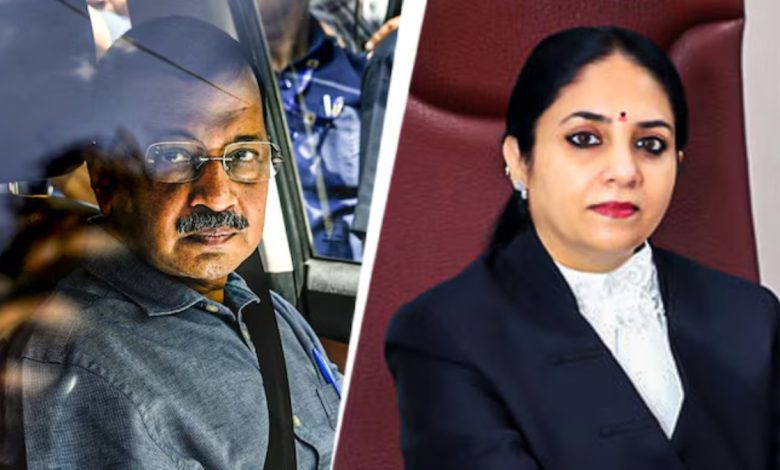
New Delhi: It isn’t often that a sitting High Court judge is asked, in open court, whether she follows a particular political ideology. Last week, that’s exactly what happened in Delhi and the person asking was Arvind Kejriwal himself.
The AAP convenor appeared in court personally to argue that Justice Swarana Kanta Sharma of the Delhi High Court should step away from his excise policy case. At 4:30 PM on Monday, Justice Sharma is set to announce her decision on whether she will do just that.
The judge at the centre of it all
Justice Sharma isn’t a name that featured much in public discourse before this. Behind the controversy is a judge with a career stretching back over three decades.
She started young. According to the Delhi High Court website, she graduated in English Literature from Daulat Ram College, Delhi University — where she was named the best all-round student of the year — before completing her LLB in 1991 and her LLM in 2004. Last year, she added a PhD to that list, with a thesis comparing judicial education systems in the UK, the US, Singapore, and Canada. She also holds a diploma in Marketing Management, Advertising, and Public Relations.



She became a magistrate at 24. By 35 — on her birthday, as it happens — she was a sessions judge. Over more than thirty years in Delhi’s district courts, she handled everything from family disputes to motor accident claims, sexual offence cases, and CBI matters. She was elevated to the Delhi High Court as a permanent judge on March 28, 2022. She has also written five books — on women navigating breakups, fiction, and judicial education.
How this blew up
The trouble started with a trial court order on February 27 this year. After going through 40,000 documents, the court discharged Kejriwal and 22 others in the excise case, finding the CBI’s material insufficient to even proceed to trial. The CBI challenged that order before the High Court.
At the very first hearing before Justice Sharma on March 9, things moved quickly — perhaps too quickly, in Kejriwal’s view. She stayed the trial court’s directive for departmental action against a CBI investigating officer and described certain observations in the trial court’s order as “prima facie misconceived.” Her critics pointed out that this happened after just five minutes of hearing the CBI, with Kejriwal’s side never getting a word in.
That hearing became the flashpoint.
What Kejriwal argued — and how it played out in court
Kejriwal first moved for the case to be transferred on March 11. That was rejected two days later. He then filed a recusal plea — and showed up to argue it himself. For a man who spent years as a government tax officer and social activist before entering politics in 2012, arguing his own case in the High Court was a pointed choice.
He put forward four grounds. The first was procedural: a thorough, document-heavy trial court order was effectively undone in five minutes without hearing him. The second was legal: under the Supreme Court’s ruling in Ranjit Thakur vs Union of India, you don’t need to prove actual bias — a reasonable apprehension of it is enough.
The third was the one that landed loudest. Kejriwal cited Justice Sharma’s attendance at four events organised by the Akhil Bharatiya Adhivakta Parishad — a lawyers’ body affiliated with the RSS, the ideological parent of the BJP, which also happens to be AAP’s biggest political rival and the party running the country.
“This case is political,” he told the court flatly.
Also Read:Congress Slams Modi Govt Over Pakistan’s Role In US-Iran Peace Moves
Justice Sharma asked whether he was implying she subscribed to that ideology. He turned the question around: “Do you?” She said she only wanted his submissions properly on record.
In a separate affidavit, Kejriwal added a fourth ground conflict of interest. Justice Sharma’s son is empanelled as a Group A counsel for the Centre before the Supreme Court. Her daughter is empanelled as a Group C counsel appearing for the Centre before the Delhi High Court. Both receive work allocation from Solicitor General Tushar Mehta the same Tushar Mehta who is arguing the CBI’s case before Justice Sharma.
The CBI’s response
The CBI wasn’t having any of it. Solicitor General Mehta called the recusal bid a “dangerous precedent.” Judges attend bar association events all the time, he argued, regardless of what those associations’ affiliations might be. On the children: neither had anything to do with the excise case, worked independently, and had no attachment to any senior advocate.
Justice Sharma reserved her order, accepted Kejriwal’s additional affidavit, and took further documents on record. Her pronouncement on whether she steps aside or stays is scheduled for 4:30 PM Monday.