
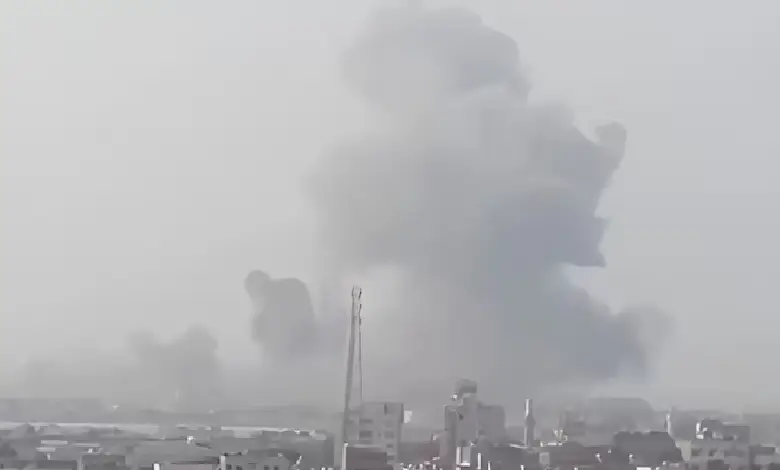
Israeli forces have announced the creation of a so-called “yellow line” in southern Lebanon, marking the first time the military has applied this designation to the country in a manner similar to its longstanding measure in the Gaza Strip.
In a statement issued on Saturday, the Israeli military reported that troops operating south of the Yellow Line in southern Lebanon had identified individuals it described as terrorists who violated ceasefire understandings by approaching from the north in a way that posed an immediate threat.
The development follows a 10-day ceasefire between Israel and Lebanon that took effect on Thursday. According to the Israeli military, actions taken in self-defence to neutralise immediate threats are not constrained by the truce agreement.
In the Gaza Strip, where a ceasefire has been in place since October, the “yellow line” has effectively divided the territory. It separates an eastern zone under Israeli military control from a western area with relatively fewer movement restrictions for Palestinians. Israeli troops have fired on individuals nearing the line, and hundreds of homes have been demolished in the controlled zone. Since the ceasefire began, Israeli attacks have killed at least 773 people and injured more than 2,000, according to reports.


Al Jazeera’s Nour Odeh, reporting from Ramallah in the occupied West Bank, described the announcement in Lebanon as a continuation of what she termed the “Gazafication” of southern Lebanon. She referenced statements by Israeli Defence Minister Israel Katz, who indicated that the army had been directed to demolish Lebanese border villages following models seen in Beit Hanoon and Rafah in Gaza, where widespread destruction has left little standing. Odeh noted that such actions equate Shia villages with Hezbollah infrastructure, treating them as equivalent threats in a manner comparable to Israel’s approach to Palestinians and Hamas in Gaza.
Despite the ceasefire, Israeli artillery strikes on Saturday targeted the southern Lebanese towns of Beit Leif, Qantara and Touline, while home demolitions continued in several areas. The military attributed these operations to responses against fighters nearing positions where its soldiers remain stationed.
Hezbollah Secretary-General Naim Qassem stated later on Saturday that the truce cannot hold unless both parties fully observe it. “A ceasefire means a complete cessation of all hostilities,” he said in a televised statement. “Because we do not trust this enemy, the resistance fighters will remain in the field with their hands on the trigger, and they will respond to violations accordingly. There is no ceasefire from the side of the resistance only; it must be from both sides.”
Qassem called for a full Israeli withdrawal from Lebanon. He outlined subsequent priorities, including the release of prisoners, the return of residents to border areas, and a major reconstruction effort supported by international and Arab backing. He also expressed Hezbollah’s willingness to cooperate with the Lebanese state on a new framework aimed at safeguarding national sovereignty and avoiding internal discord.
The latest ceasefire follows an earlier arrangement that had nominally been in force since November 27, 2024. The United Nations has documented more than 10,000 Israeli ceasefire violations during that period, along with hundreds of Lebanese deaths.
Israel has insisted to the Lebanese government that Hezbollah must disarm for any truce to endure. Hezbollah, in turn, has conditioned its compliance on Israel’s complete withdrawal from southern Lebanon, as envisaged in the 2024 ceasefire understanding. The Lebanese government has taken steps toward disarming Hezbollah south of the Litani River and previously outlawed the group’s military wing, while expressing concerns over Israeli operations. Lebanese President Joseph Aoun had declined direct talks with Israeli Prime Minister Benjamin Netanyahu.
On Thursday, US President Donald Trump announced the ceasefire and indicated that Netanyahu and Aoun could meet in Washington in the coming weeks to discuss ending the conflict.