
[By Devansh Desai Mumbai Samachar Desk]
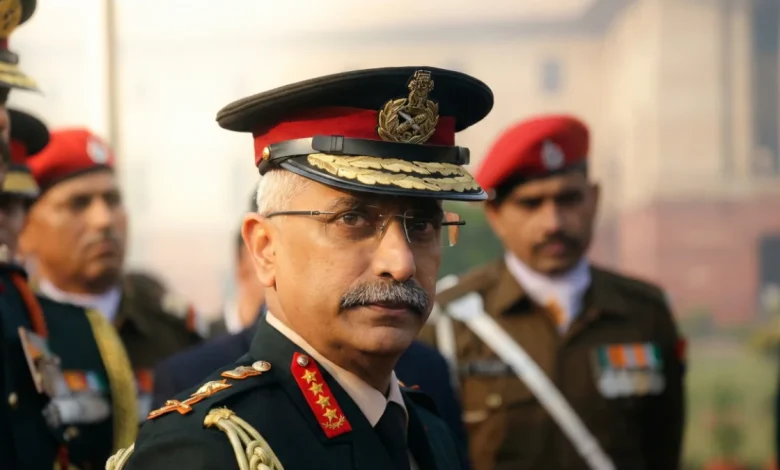
When Chinese tanks rolled toward Indian positions in Ladakh during August 2020, then Army Chief General Manoj Mukund Naravane faced what he later described as a “hot potato” — a moment that could have sparked the first major armed conflict between two nuclear powers along the Line of Actual Control.
According to revelations from his unpublished memoir, Four Stars of Destiny, General Naravane sought guidance from Defence Minister Rajnath Singh during this razor-edge confrontation. The minister’s response was succinct yet profound: “Jo uchit samjho, woh karo” exercise your judgment.
This exchange encapsulates a pattern that has defined India’s civil-military relations for over seven decades: political leaders establish strategic objectives, while military commanders retain operational autonomy.
A Historical Pattern of Strategic Trust
The Ladakh crisis was not the first instance where India’s political establishment entrusted battlefield decisions to military leadership. Since independence, successive governments have consistently provided broad strategic direction while avoiding micromanagement of tactical operations.


Prime Minister Jawaharlal Nehru deployed the Indian Army to Jammu and Kashmir on October 27, 1947, to counter Pakistani raiders. After fifteen months of fighting, he accepted a United Nations-brokered ceasefire on January 1, 1949, though this left Gilgit-Baltistan and Pakistan Occupied Kashmir under Pakistani control.
In 1971, Prime Minister Indira Gandhi authorized the liberation of Bangladesh but delegated war-fighting entirely to military commanders. The armed forces correctly determined that capturing Dhaka would precipitate the collapse of Pakistan’s eastern garrison.
During the 1999 Kargil conflict, Prime Minister Atal Bihari Vajpayee directed the Army and Air Force to expel Pakistani intruders without crossing the Line of Control. The objective was achieved, though 527 Indian soldiers lost their lives in the operation.
The Cost of Political Interference
The 1962 war with China stands as a stark exception and cautionary tale about political interference in military operations.
Leaked portions of the still-classified Henderson Brookes report reveal how political pressure drove numerous tactical errors that contributed to India’s defeat. Among the most serious mistakes was Prime Minister Nehru’s public announcement that he had ordered the Army to evict Chinese forces. When China launched its offensive on October 20, 1962, Indian Air Force fighter jets were not deployed to strike PLA logistical lines a controversial decision that remains divisive today.
Operation Parakram: When Orders Never Came
The contrast between political trust and political hesitation becomes clearer when examining Operation Parakram. Four days after Pakistani terrorists attacked India’s Parliament on December 11, 2001, the political leadership launched the largest peacetime mobilization of Indian armed forces along the Pakistan border.
During deployment discussions, Army chief General S Padmanabhan asked Prime Minister Vajpayee for his orders. According to an officer present at the conversation, the response was: “Aap chaliye, hum batayenge” go ahead, we will tell you what to do.
Those orders never arrived. Multiple factors, including American pressure and fears of nuclear escalation, led to restraint. The Army remained deployed along the Pakistan border for nearly ten months before being recalled.
General Padmanabhan, who passed away in 2024, never published a memoir. However, research analyzing the standoff reveals a political leadership concerned about nuclear war, rejecting various military options ranging from cross-border land and air strikes in Pakistan Occupied Kashmir to targeting the Jaish-e-Mohammed headquarters in Bahawalpur. Former Air Chief ACM S Krishnaswamy confirmed that airstrikes on Bahawalpur and naval blockade of Karachi were both declined.
The Ladakh Calculus
The 2020 Ladakh situation presented distinct challenges. Since 1996, protocols between India and China explicitly prohibited force or military mobilization along the LAC. China’s People’s Liberation Army violated these agreements by deploying two infantry divisions supported by tanks and artillery in Ladakh, backing a series of skirmishes along the LAC that breached all “peace and tranquillity” agreements.
In May 2020, India’s political leadership ordered the largest military mobilization in Ladakh since 1962. Two army corps comprising over 50,000 soldiers, backed by tanks and artillery, were dispatched to the region. Critically, unlike in 1962, IAF fighter jets were prepared for offensive air strikes against the PLA.
The PLA’s fury stemmed from being outmaneuvered by Indian Army deployments that captured the Kailash Range, south of Pangong Tso Lake. When Chinese tanks advanced toward Indian positions, it marked the only moment during the standoff when the Indian Army considered deploying heavy artillery. A single salvo from six 155-mm Bofors guns can saturate an area equivalent to ten football fields with a tonne of explosives, capable of stopping tanks completely.
The Judgment Call
General Naravane assessed that the Chinese tanks intended to intimidate rather than attack. As detailed in excerpts from Four Stars of Destiny published in a magazine article, he directed Northern Army commander Lt General YK Joshi to position four Indian tanks on the forward slopes of the pass with guns depressed, “so the PLA would be staring down the barrels of our guns.” This was executed immediately. The PLA tanks, which had advanced to within a few hundred meters of the hilltop, halted.
“Their light tanks would have been no match for our medium tanks. It was a game of bluff and the PLA blinked first,” General Naravane wrote.
What remained unstated in his memoir was that the Indian Army had deployed T-90 tanks to Ladakh years before the standoff began. A former Corps Commander revealed that the Army had developed specific tactics for T-90s to advance on ridges to counter the PLA’s lighter, faster tanks — tactics that proved invaluable in 2020, demonstrating to the PLA they faced an evenly matched adversary. The standoff ultimately de-escalated in October 2024.
Operational Autonomy as Doctrine
“India’s political leadership are not military strategists, they give you the broad contours of what to do — they never get into the details of war fighting, it is for the military leadership to provide options,” explained a former General Officer Commanding-in-Chief.
Also Read: Former Army Chief Naravane Urges Diplomacy Over War in India-Pakistan Ceasefire
Field commanders have occasionally exercised independent judgment even during active combat. As General Officer Commanding 4 Corps in 1971, Lt General Sagat Singh defied his immediate superior, Eastern Army Commander Lt General JS Aurora, who had ordered him not to cross the Meghana River. Singh launched an audacious helicopter airlift of troops across the river, bypassing Pakistani defenses in the advance toward Dhaka.
Was Seeking Political Guidance Appropriate?
Military analysts unanimously support General Naravane’s decision to consult political leadership.
“When [we] went through the Kailash Range operations without firing a bullet, from there to escalate is a big step. Anyone would be very wary of firing a shot because that tactical permission has geo-strategic ramifications, and hence, I don’t see anything wrong in the chief asking for orders,” said Lt General PR Shankar, former Director General Artillery.
The opposition has criticized the government for indecisiveness during the standoff. While the Ladakh episode might superficially appear as politicians shirking responsibility, examining military “hot potatoes” over the past 78 years reveals that India’s political class consistently provides broad strategic outlines while rarely interfering with operational military conduct.
“Everyone has done the right thing in Ladakh, yet the entire episode reeks of making a failure out of a success,” Lt General Shankar observed.
The Ladakh standoff ultimately underscores a fundamental principle: in moments of potential conflict, the balance between political oversight and military autonomy can determine whether a nation stumbles into war or steps back from the precipice. General Naravane’s decision to seek guidance — and the Defence Minister’s trust in his judgment — may well have prevented a catastrophic escalation between two nuclear-armed neighbors.
“BASED ON RECENT REVELATIONS FROM GENERAL NARAVANE’S MEMOIR AND HISTORICAL CIVIL-MILITARY PRECEDENTS.”