
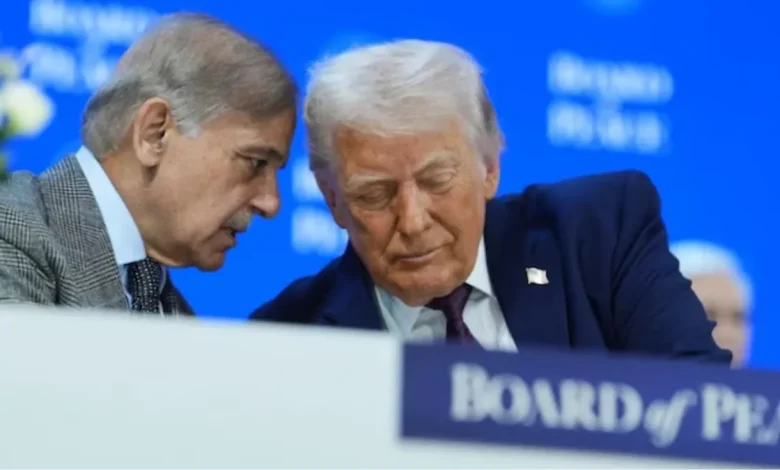
United States President Donald Trump introduced his proposed “Board of Peace” initiative on Thursday during the World Economic Forum in Davos, but India refrained from participating in the launch event even as Pakistan Prime Minister Shehbaz Sharif joined Trump on stage, raising questions about the venture’s perception, purpose and international acceptance.
The unveiling ceremony at the Swiss mountain resort followed a structured format. Participating leaders approached in pairs, seated themselves next to Trump at an extended table and affixed their signatures to the charter. Sharif occupied the seat directly to Trump’s right, shook hands with the US President and engaged in brief conversation before signing, a sequence that attracted notice given the ongoing examination of who participated and how they were positioned.
India featured prominently among major nations that did not attend the launch, though Prime Minister Narendra Modi had received an invitation to participate. New Delhi neither formally accepted nor rejected the proposal, according to sources with knowledge of the situation. Approximately 35 nations signed the charter following several weeks of diplomatic engagement by Washington. France, the United Kingdom, China and Germany were also absent from the proceedings.
INDIA EVALUATES PROPOSAL WHILE PAKISTAN PARTICIPATES
India’s non-participation became more conspicuous with Pakistan joining Trump and fellow leaders at the ceremony. The visual presentation is not expected to have been received favourably in New Delhi, which has continuously highlighted Pakistan’s involvement in cross-border terrorism, including the April 22 assault in Pahalgam in Jammu and Kashmir.



Government officials indicated India was assessing the invitation, considering the delicate geopolitical and security matters at stake. New Delhi has maintained steady support for a two-State resolution to the Palestine issue, advocating for Israel and Palestine to coexist peacefully within internationally recognised boundaries.
Also Read:EC On US Being Cited During SIR Hearing
Pakistan secured membership in the Board of Peace, joining Argentina, Armenia, Azerbaijan, Bahrain, Belarus, Egypt, Hungary, Kazakhstan, Morocco, the United Arab Emirates, Saudi Arabia and Vietnam. Multiple other countries, including Germany, Italy, Paraguay, Russia, Slovenia, Turkiye and Ukraine, have not yet committed.
TRUMP REITERATES INDIA-PAKISTAN ASSERTION
Speaking to attendees, Trump once more stated that his involvement had prevented armed conflict between India and Pakistan, reaffirming a claim New Delhi has rejected.
“We were very happy to stop the war that had started between India and Pakistan, two nuclear nations,” Trump stated. “I was very honoured when the Prime Minister of Pakistan said President Trump saved 10 to 20 million lives by getting that stopped just before bad things were going to happen.”
Trump had expressed a comparable statement one day prior during a special address at the World Economic Forum, contending that trade and tariff influence enabled Washington to avert conflicts.
The comments reference the May 2025 tensions that followed Operation Sindoor, precision military actions conducted by India targeting terrorist infrastructure in Pakistan and Pakistan-occupied Jammu and Kashmir.
NEW ORGANISATION WITH WORLDWIDE OBJECTIVES
Trump has presented the Board of Peace as an international body designed to advance stability, restore legitimate governance and achieve “enduring peace” in regions experiencing or facing conflict. Originally envisioned to supervise governance and coordinate financing for Gaza’s reconstruction following two years of Israeli military operations, its charter describes wider responsibilities.
“Once this board is completely formed, we can do pretty much whatever we want to do. And we’ll do it in conjunction with the United Nations,” Trump remarked at the ceremony, noting that the UN possessed “great potential” that had not been completely realised.
The board will operate under Trump’s chairmanship and, at its highest tier, will comprise exclusively heads of state. Washington has indicated it will hold a central position in executing Trump’s 20-point Gaza plan, which encompasses transforming the territory into a deradicalised, terror-free zone and reconstructing it for residents’ welfare.
QUESTIONS ABOUT UN FUNCTION
The project has generated apprehension in numerous capitals, with diplomats wondering whether it might undermine the United Nations’ standing as the principal platform for global diplomacy and conflict resolution. Beyond the US, no other permanent UN Security Council member has pledged to join.
France has refused participation, Britain has stated it is not joining presently, and China has not clarified its stance. Russia mentioned it was reviewing the proposal, with President Vladimir Putin signalling Moscow’s readiness to provide funding to assist Palestinians.
A UN spokesperson confirmed any collaboration with the Board of Peace would occur within parameters established by a Security Council resolution supporting Trump’s Gaza plan.
EXECUTIVE BOARD AND GAZA EMPHASIS
The White House has revealed a founding executive board to implement the initiative. Its composition includes US Secretary of State Marco Rubio, former British prime minister Tony Blair, US Middle East envoy Steve Witkoff, businessman and Trump’s son-in-law Jared Kushner, World Bank president Ajay Banga, Apollo Global Management chief executive Marc Rowan and US national security adviser Robert Gabriel.
The executive board will manage an administrative structure designated as the National Committee for the Administration of Gaza.
Also Read:Trump Warns Hamas As Gaza Board Of Peace Signed In Davos
Rubio stated the board’s immediate priority would be guaranteeing the Gaza plan’s implementation, while simultaneously demonstrating “an example of what’s possible in other parts of the world”.
Kushner indicated the subsequent phase of the Gaza ceasefire would concentrate on reconstruction financing and Hamas disarmament. “If Hamas doesn’t demilitarise, that would be what holds this plan back,” he stated.
The board’s introduction arrives during a tenuous ceasefire in Gaza, established in October, which has witnessed repeated breaches and mutual accusations from both Israel and Hamas. Israel claims Hamas has postponed returning a final hostage’s body, while Hamas accuses Israel of limiting aid as the humanitarian emergency intensifies.