
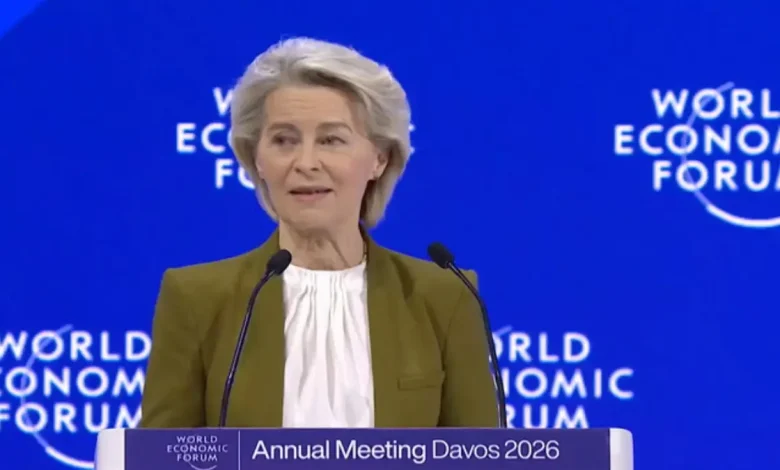
Davos : European Commission President Ursula von der Leyen said at the World Economic Forum in Davos on Tuesday. The European Union (EU) top official was referring to the EU-India Free Trade Agreement (FTA), that the two sides have been painstakingly working on for nearly two decades now. The EU-India FTA is a study in contrast to the trade deal that American President Donald Trump is trying to dictate between India and the US.
While the India-EU FTA has been in the works for almost 20 years, negotiations on a India-US trade deal began in February 2025. However, the White House has already become impatient, with Commerce Secretary Howard Lutnick, referring to Trump’s staircase model of deal-making, where delays are punished. While the EU’s von der Leyen cautioned that a few issues remain, many experts see the deal as effectively concluded.
How did India and the EU come to agreement on the deal after two decades of back and forth? How will both sides benefit? And how will an FTA between the world’s fastest growing economy and one of the most developed bloc of countries end up rocking US President Donald Trump’s boat far more than he had bargained for? After stalling in 2013, talks were revived in June 2022 due to shifting global trade and security dynamics, and gained further urgency after the Trump administration changed its trade policies that pivoted the US economy to a more protectionist stance, and forced traditional US trade partners to seek alternative markets.
The shared challenge of China was also a significant factor in the negotiations between both sides. On one hand, Indian industries like solar components manufacturing have struggled to scale up production due to being undercut by much cheaper Chinese counterparts. On the other hand, the EU has grown increasingly concerned about China’s predominance in manufacturing, which exposes the bloc to risks like local industries failing to compete with their Chinese counterparts.




Momentum accelerated in 2025 following European Commission President Ursula von der Leyen’s February visit to India with the full College of Commissioners and a joint pledge to conclude negotiations by year-end. Since then, more than 14 negotiating rounds, ministerial-level interventions, including Commerce Minister Piyush Goyal’s January 2026 visit to Brussels, and narrowed gaps in market access and services have pushed the deal forward.
The partnership is mutually complementary. India is among the world’s fastest-growing economies, with the IMF projecting 7.3% GDP growth between FY2024–26. Its 1.46-billion-strong population offers the EU a vast and expanding market, helping cushion potential trade shocks involving the US or China.
For India, the EU represents one of the world’s most developed economic blocs, with a combined GDP of $22.52 trillion in 2026, or about one-sixth of the global economy. Its integrated market—anchored by systems such as the Schengen Zone—would give Indian goods and services access to 27 countries, while an FTA would also unlock greater investment, co-development and technology transfers, helping India narrow the gap with China’s more advanced economy.
Read Also : Udhayanidhi’s Remarks On Udhayanidhi Are ‘Hate Speech’ Says Madras High Court