
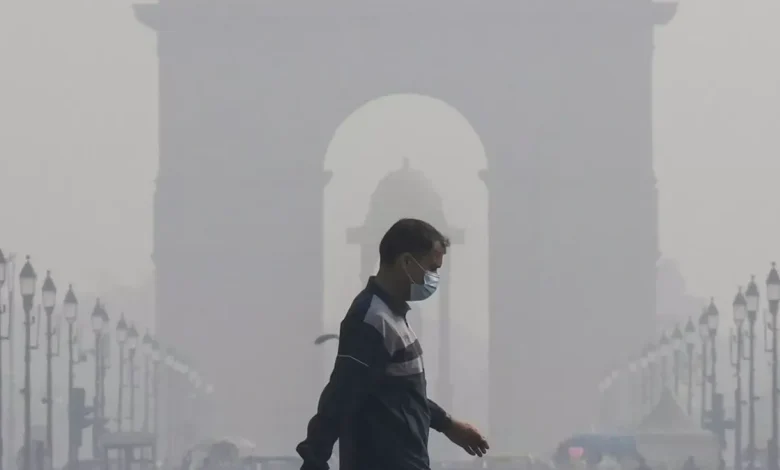
Air quality in Delhi dropped to the ‘severe’ category on Saturday (January 17), leading authorities to activate stage IV restrictions under the Graded Response Action Plan (GRAP) in the National Capital Region and adjoining areas. Delhi’s AQI was measured at 400 at 4 pm with signs of additional worsening to 428 by 8 pm owing to adverse meteorological conditions caused by the influence of western disturbances coupled with low wind speeds.
The Commission for Air Quality Management in NCR and Adjoining Areas (CAQM) declared Saturday evening a ban on truck traffic entry into Delhi, excluding vehicles carrying essential commodities and providing essential services.
Also Read: Congress MLA Phool Singh Baraiya Sparked Major Political Outrage
The most severe restrictions under GRAP measures were imposed a day after authorities put GRAP 3 measures into effect to prevent further air quality decline. Experts state that exposure to air quality beneath satisfactory levels, an AQI of 100, can cause respiratory and cardiac problems, particularly among children, elderly persons, and individuals with existing medical conditions.




At the same time, visibility has been impacted throughout the region as cold wave conditions continued in the national capital and dense fog covered significant portions of the city. The heavy fog surrounding the airport area also caused certain flight delays because of reduced visibility.
Based on CPCB classification, an AQI ranging from 0-50 is categorized as ‘Good’, 51-100 ‘satisfactory’, 101-200 ‘moderate’, 201-300 ‘poor’, 301-400 ‘very poor’, and 401-500 is classified as ‘severe’.
What are the measures under GRAP-IV restrictions?
Stage four of GRAP rules is viewed as the most stringent, featuring measures including a complete prohibition on construction and demolition activities across Delhi. Stone crushing, mining operations and other associated activities must be halted under these rules, as such activities are primary contributors to dust and particulate pollutants in the atmosphere.
Educational institutions have been directed to adopt hybrid modes for classes up to standard 5, intended to limit young children’s exposure to hazardous air pollution.
Transportation restrictions have also been strengthened across the National Capital Region. Authorities have instructed NCR state governments and the Government of the National Capital Territory of Delhi to strictly limit the movement of BS-III petrol and BS-IV diesel light motor vehicles, including four-wheelers.
These measures extend beyond the national capital and will be implemented in major neighboring districts including Gurugram, Faridabad, Ghaziabad and Gautam Buddha Nagar.