
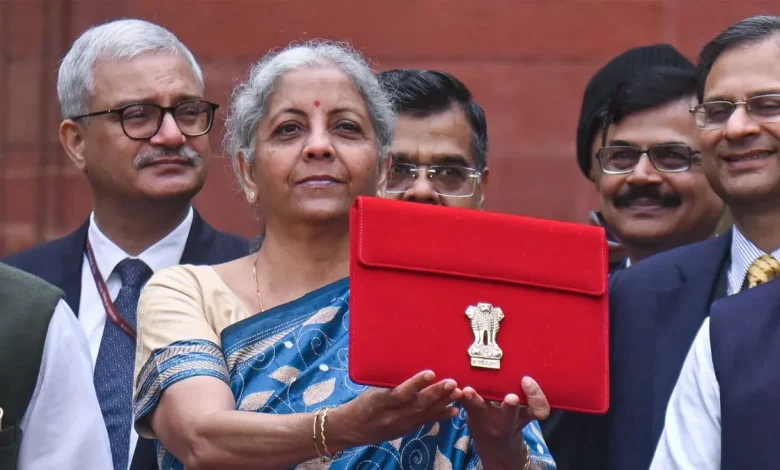
Finance Minister Nirmala Sitharaman is set to deliver the Union Budget 2026 on February 1, a Sunday, as she prepares to present her ninth consecutive budget. This marks the Modi 3.0 government’s second complete budget, after the first was tabled in 2025.
Historically, the budget was unveiled on February 28 each year until 2017, when the Modi administration moved the date forward to February 1 to facilitate faster rollout of fiscal measures.
The upcoming budget is anticipated to emphasize maintaining economic growth while providing relief to middle-income earners, who face challenges from substantial tax burdens, rising cost of living, and strained household budgets.
With this presentation, Sitharaman edges closer to the historic benchmark of 10 Union Budgets set by former Prime Minister Morarji Desai. Already having presented eight straight budgets—including the interim budget in February 2024—she will establish herself as the sole finance minister to have delivered nine consecutive budgets under one prime minister. Here’s an overview of India’s budgetary evolution.


India’s Budget Timeline: A Historical Overview
First Post-Independence Budget
The inaugural Union Budget of independent India was introduced on November 26, 1947, by R.K. Shanmukham Chetty, the nation’s first finance minister.
Budget Presentation Schedule
For many years, the budget was announced at 5 pm on February’s final working day, a tradition inherited from colonial times that synchronized Indian announcements with UK business hours. India’s time zone, four hours and 30 minutes ahead of British Summer Time, allowed the budget to reach London during working hours.
Change to 11 am
In 1999, finance minister Yashwant Sinha, serving under Prime Minister Atal Bihari Vajpayee’s administration, shifted the budget presentation to 11 am—a practice that remains in effect.
February 1 Becomes Standard Date
The government moved the budget date from February 28 to February 1 in 2017, allowing expedited Parliamentary clearance and enabling implementation right from the financial year’s beginning on April 1. Previously, procedural bottlenecks frequently delayed execution until May or June.
Record-Holders for Most Union Budgets
Morarji Desai – 10 Budgets (all-time record): Morarji Desai holds India’s record for presenting the most Union Budgets—six from 1959 to 1964, and another four from 1967 to 1969, during the tenures of Prime Ministers Jawaharlal Nehru and Lal Bahadur Shastri.
P. Chidambaram – 9 Budgets: P Chidambaram presented nine budgets, starting in 1996 under the United Front government and later introducing several budgets during the Congress-led UPA administration from 2004 to 2009.
Pranab Mukherjee – 8 Budgets: Pranab Mukherjee tabled eight budgets over different terms, including five straight budgets between 2009 and 2012 during the UPA government.
Additional Budget Landmarks
Prior to becoming Prime Minister, Dr. Manmohan Singh held the finance portfolio under Prime Minister PV Narasimha Rao, presenting five consecutive budgets from 1991 to 1995. His 1991 budget is particularly significant for launching India’s economic liberalization reforms.
Budget Speech Records
Longest Budget Speech: Nirmala Sitharaman set the record for the lengthiest budget speech on February 1, 2020, which extended to 2 hours and 40 minutes, ending with two pages remaining undelivered.
Shortest Budget Speech: The briefest budget speech was presented by Hirubhai Mulljibhai Patel in 1977, whose interim budget address comprised merely 800 words.