
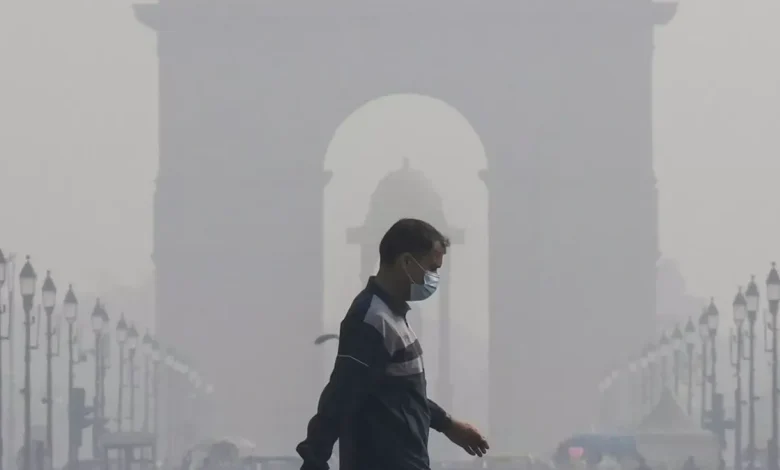
Delhi-NCR authorities have activated the most stringent anti-pollution measures under Stage-IV of the Graded Action Response Plan (GRAP) following a sharp decline in air quality to severe levels on Saturday, necessitating emergency intervention to prevent further degradation. The harshest pollution controls were enacted just hours after GRAP-III measures took effect.
The Commission for Air Quality Management (CAQM) made the decision after Delhi’s Air Quality Index (AQI) displayed a rapidly deteriorating pattern on Saturday.
Government data revealed the AQI dropping from 431 around 4 pm to 441 by 6 pm, raising fears that pollution could soon cross the “Severe+” mark.
The CAQM attributed the surge to sluggish wind movement, atmospheric stability, adverse weather patterns and inadequate pollutant dispersion.
Heavy toxic fog blanketed Anand Vihar this evening with AQI climbing to 488, categorized as ‘severe’ by the Central Pollution Control Board, creating significant health risks.
Dense smog shrouded India Gate and Kartavya Path this evening as air quality deteriorated to severe levels, recording an AQI of 407.
Responding to the declining conditions, the CAQM’s Sub-Committee on GRAP activated all Stage-IV protocols, the maximum restriction level, effective immediately throughout the National Capital Region.
A primary measure under GRAP-IV includes a total prohibition on construction and demolition work across Delhi. Officials have ordered the shutdown of stone crushing facilities, mining ventures and related operations throughout the NCR, identified as major sources of dust and particulate matter pollution.
Schools have been instructed to adopt hybrid teaching models for classes through Class 5, minimizing young children’s exposure to dangerous air. Educational institutions must limit in-person attendance while maintaining academics through combined online and physical instruction.
Transportation controls have been strengthened. NCR state administrations and Delhi’s government must enforce strict limitations on BS-III petrol and BS-IV diesel light motor vehicles (four-wheelers).
GRAP-IV Measures Summary
Classes through Class 5 to function in hybrid format
Total prohibition on construction and demolition work
Closure of stone crushing facilities across NCR
Halt of all mining and associated operations in NCR
Stringent controls on: BS-III petrol four-wheelers; BS-IV diesel four-wheelers
Vehicle limitations enforced in: Delhi, Gurugram, Faridabad, Ghaziabad, Gautam Buddha Nagar
These restrictions extend beyond Delhi to major neighboring districts including Gurugram, Faridabad, Ghaziabad and Gautam Buddha Nagar.
These actions supplement existing controls from Stages I, II and III of the action framework. Additionally, the CAQM has instructed pollution control authorities, enforcement departments and municipal bodies across NCR to intensify preventive and compliance operations for strict GRAP-IV adherence.
Officials must strengthen surveillance, penalize violations and coordinate efforts to prevent further air quality decline.
Authorities emphasized that GRAP-IV activation occurs when air quality reaches critically poor levels requiring urgent intervention for public health protection. The measures target emission reduction at sources during unfavorable weather when pollutants concentrate quickly.
Citizens are advised to minimize outdoor exposure, especially during early morning and late evening periods, and follow health and civic authority guidelines.
The situation remains under continuous observation, with additional measures possible if pollution persists in upcoming days.
Health Hazards from Severe AQI
Extended exposure to severe air pollution may cause:
– Worsening of asthma and breathing conditions
– Diminished lung capacity
– Elevated cardiovascular strain
– Irritation of eyes, throat and nasal passages
– Heightened vulnerability for those with existing conditions, children and seniors
Zero Stubble Burning Recorded in Delhi
Per the Delhi Chief Minister’s Office, CM Rekha Gupta announced the city documented no stubble burning incidents this year despite approximately 7,000 acres of paddy cultivation.
She attributed the accomplishment to rigorous oversight and robust farmer cooperation, describing it as a critical move toward cleaner air.
Read More: Pollution Refugees Seek Cleaner Air Beyond Metros
This achievement represents a major environmental breakthrough for the national capital, which typically experiences severe pollution during crop residue burning periods in adjacent states.
Would you like me to adjust the structure to emphasize the health impacts or the zero stubble burning achievement more prominently?