
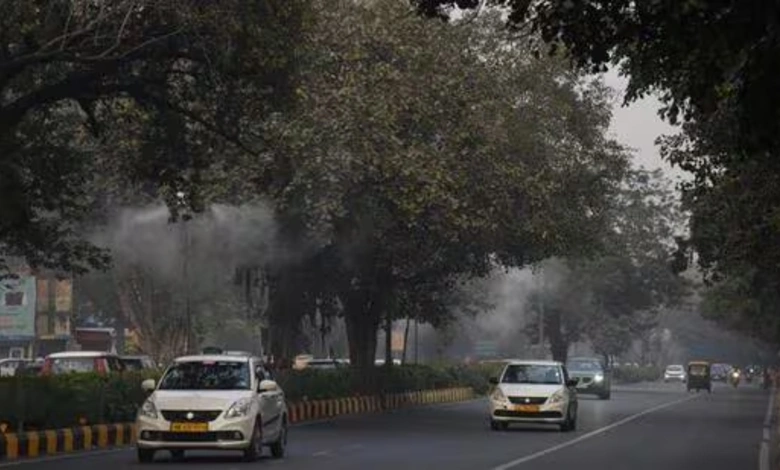
Delhiites faced yet another dismal dawn on Friday, with the city’s air quality index (AQI) sliding deeper into hazardous territory compared to the previous evening. Data from the Central Pollution Control Board (CPCB)’s Sameer app indicated an overall AQI of 324 at 7:05 AM, marking a 20-point increase from the 304 logged late Thursday and solidifying the “very poor” classification across much of the capital.
Out of 40 monitoring stations, 31 reported readings in the “very poor” range, led by RK Puram at a staggering 374. Trailing just behind were Bawana at 373 and Nehru Nagar at 366. The least affected site, Mandir Marg, clocked in at 222, while NSIT in Dwarka fared slightly better at 266—both still falling under the “poor” bracket.
Compounding the respiratory woes, the India Meteorological Department (IMD) has issued a forecast of cold wave conditions at isolated spots, alongside a mostly overcast sky and morning shallow fog. Temperatures are projected to bottom out at 5 degrees Celsius overnight, with daytime highs dipping to 23 degrees Celsius from Thursday’s 23.1 degrees. Expect northwest winds dominating at speeds up to 10 kmph in the morning, easing below 12 kmph by afternoon before settling under 10 kmph through the evening and night, as per the Air Quality Early Warning System for Delhi.
ALSO READ : Delhi’s Smoggy Skies Ease Slightly, But Toxic Haze Clings to Key Neighborhoods


In a stark reminder of the capital’s persistent pollution crisis, a fresh analysis by the Centre for Science and Environment (CSE) highlights the escalating toxicity in Delhi’s atmosphere during early winter (October-November) and over the full year. The study reveals a stalling of long-term air quality improvements, alongside deteriorating conditions in smaller National Capital Region (NCR) towns and the emergence of new hotspots.
Despite a reduced role from seasonal farm fires, Delhi’s AQI has veered into “very poor” to “severe” levels, underscoring the dominance of local emitters like vehicles and combustion processes. “Delhi and NCR cannot hide behind the smokescreen of farm fires any more as even with much lesser contribution to local air quality this time, air quality has turned very poor to severe, exposing the impact of local sources. However, more worrying is the daily synchronised rise of PM2.5 and other toxic gases, including nitrogen dioxide (NO2) and carbon monoxide (CO), largely from vehicles and combustion sources, creating a toxic cocktail that has gone unnoticed. The long-term air quality trend in Delhi has also plateaued without showing improvement. This signals an urgent need for deep-rooted shifts in infrastructure and systems to upscale action to cut emissions from vehicles, industry, power plants, waste, construction and household energy,” stated Anumita Roychowdhury, executive director at CSE, in the report.
The assessment also flags the NCR’s widespread pollution persistence and intensified smog episodes in outlying areas. “What further stands out is the stubborn stability and the vast spread of the pollution levels across the NCR region, as well as the worsening and proliferation of more pollution hotspots in the city. The tinier towns in the region display more intense and longer-lasting smog buildup. Even though the peak pollution spikes are lower this winter due to lesser contribution of farm fires, the airshed is getting increasingly more saturated,” added Sharanjeet Kaur, deputy programme manager, Urban Lab, Clean Air unit.